Trump's AI Preemption Push: What Executives Need to Do Now
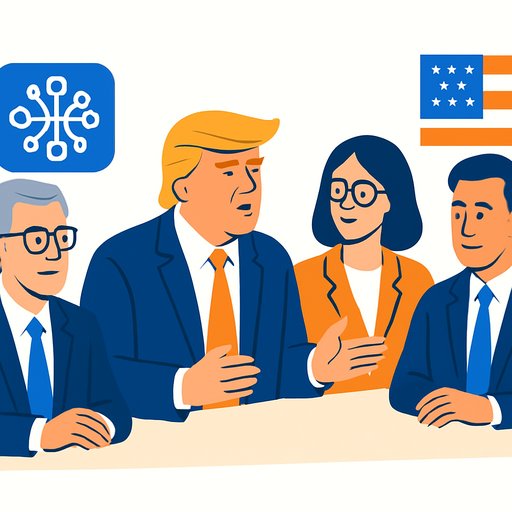
President Donald Trump signed an executive order to curb state-level AI regulation. The move, driven by top AI adviser David Sacks, aims to force a single federal standard and stop what he called "a confusing patchwork" of rules.
Tech leaders agree on the goal. But the method - a hard shove from the White House instead of a congressional deal - has sparked backlash across parties and states, and introduced new uncertainty for companies planning AI rollouts.
Why this matters to your strategy
The order attempts to preempt state AI laws and direct federal agencies to push back on states. Legal experts and industry groups expect court challenges, and many doubt the order will hold up as a durable shield.
Congress had been inching toward a compromise: preemption in exchange for federal rules on kids' safety and frontier models. That momentum stalled. California's recent AI safety law - a rare win blending industry, Democrats, and pro-business Republicans - is now a flashpoint.
The result: uncertainty. As one investor put it, "Businesses don't like uncertainty… and this is an uncertain future for any EO." Governors and attorneys general from both parties are signaling they'll defend state action.
Where the politics stand
Sacks helped write and sell the order. Supporters cite his wins on crypto and chips policy. Critics - including some on the right - say the approach bulldozed potential deals and made AI a partisan fight.
California's governor blasted the order. Florida's governor said his state has the right to regulate AI and would likely prevail in court. On the Hill, efforts to tuck a preemption deal into the defense bill died after the order leaked and hardened positions.
The final order did soften slightly, carving out room for states to regulate AI's impact on children. Still, many expect a legal fight with limited short-term relief for industry.
What to expect next
- Litigation over federal preemption vs. state authority. Injunctions are likely, which prolongs uncertainty.
- States will keep legislating. Expect action in California, New York, Texas, Florida, and others.
- Congress may revisit a federal framework, but timing is unclear. Some expect movement in 2026.
- Federal agencies may selectively challenge states - but outcomes will vary by circuit.
Executive playbook: De-risk your next 12-18 months
- Run dual-track compliance. Assume the EO could stall. Build to a national baseline while meeting stricter state rules where you operate.
- Adopt a credible standard. Use the NIST AI Risk Management Framework for model, data, and monitoring controls. It travels well across regulators.
- Treat minors' safety as nonnegotiable. The order's carveout makes this a safe bet for enforcement. Stand up content filters, age gating, and abuse reporting with audit trails.
- Segment product risk. Gate or geofence high-risk features (synthetic media, biometric inference, autonomous actions) until you have state-ready controls.
- Contract for volatility. Add "regulatory pivot" clauses with vendors and customers to adjust data use, disclosures, and model behavior without renegotiation.
- Strengthen model governance. Document model cards, evaluation thresholds, red-teaming, and rollback plans. Keep an approval log for significant model changes.
- Vendor accountability. Require attestations on training data provenance, eval results, child-safety controls, and incident response times.
- Public affairs and legal. Join coalitions, prepare testimony, and brief state AGs early. Budget for amicus and compliance engineering, not just lobbying.
- Board oversight. Quarterly brief on regulatory exposure, state-by-state risk, and incident metrics. Tie executive comp to AI risk objectives.
- Scenario plan. Model three paths: EO stands, EO enjoined, federal deal passes with partial preemption. Define triggers for spend, launches, and GTM changes.
Signals to watch
- Early injunctions in challenges to the order - these will set the tone for preemption claims.
- State bills targeting safety, transparency, synthetic media, and liability standards.
- Congressional movement on a package pairing preemption with kids' safety and frontier model rules.
- Agency guidance that hints at how DOJ or Commerce will treat state action.
Bottom line for operators
Don't bet your roadmap on a clean federal preemption. Assume you'll be selling into a mixed rule set for at least a year. Build to a strong national baseline, add state overlays where you operate, and keep your product toggles ready.
This isn't about winning a DC argument. It's about keeping launches on track, reducing legal drag, and proving you can ship safely under scrutiny.
Helpful resources
- State activity tracker: NCSL: Artificial Intelligence Legislation
- AI Learning Path for Regulatory Affairs Specialists - upskill teams on compliance and state/federal readiness.
- AI Learning Path for CIOs - guidance on governance, oversight, and executive strategy.
- AI Learning Path for Project Managers - practical help to de-risk AI programs and manage cross-functional rollouts.
Your membership also unlocks: