AI and the new defence advantage: how militaries can win the race for decision superiority
AI has shifted from lab demos to frontline capability. It is reshaping how forces sense, decide, act, and sustain across air, land, sea, cyber, and space. The question is no longer "if," but "how fast can we deploy at scale without losing control."
The decisive edge goes to organisations that combine machine speed with human judgement, trusted autonomy, and resilient digital infrastructure. That is what decision superiority looks like in practice.
Human + machine: the new decision model
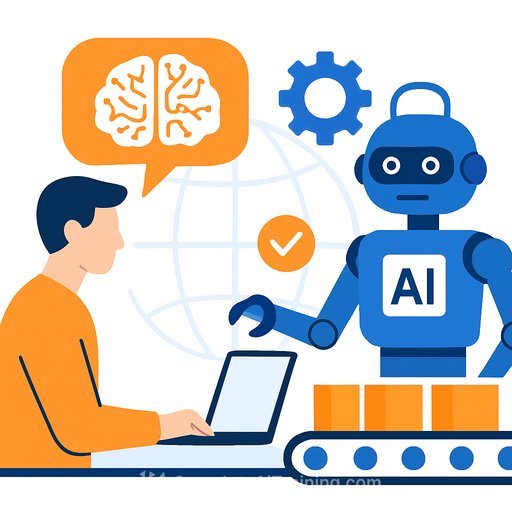
AI accelerates the OODA loop, but humans still own judgement, escalation, legality, and accountability. The winning pattern is human-on-the-loop for high-tempo operations, with AI handling sensing, fusion, and course-of-action generation.
Expect wider use of digital twins, automated target recognition, and real-time mission analysis. The goal is simple: better decisions under uncertainty, at higher tempo, without losing meaningful human control. The risk isn't using AI - it's not having people who can work with it as fast as adversaries do.
The real blockers to scaling AI
- Data fragmentation and governance: Defence data is siloed, inconsistently classified, and locked in legacy systems. AI thrives on clean, discoverable, interoperable data. "Data as a foundation" isn't a slogan; it's the first milestone.
- Acquisition built for hardware, not software: AI needs modular architectures, continuous updates, and rapid validation. Multiyear, single-drop programmes stall momentum.
- Talent gaps: There's a shortage of AI-fluent leaders, product teams, programme managers, and technical specialists. Outsourcing core digital capability limits assessment, testing, and safe adoption.
- Interoperability barriers: Without shared standards, model validation methods, and compatible architectures, pilots stay isolated and fail during combined operations.
Cyber defence: where AI helps - and where it hurts
AI already delivers value in cyber. It detects anomalies, predicts threats, and triggers automated containment at machine speed. Threat intel platforms can fuse open-source data, classified sensors, and dark web signals to anticipate campaigns.
But exposure is growing. Adversarial attacks (poisoning, evasion, manipulation) demand rigorous testing and runtime assurance. Supply chain risk is strategic: foreign chips, third-party clouds, and opaque components can hide problems. Over-reliance on automation dulls operator judgement. Teams must learn to challenge alerts, read confidence levels, and spot deception.
Procurement that matches software speed
Acquisition should operate like a digital ecosystem, not a linear chain. Speed and safety can co-exist with the right governance.
- Modular, iterative procurement: Move to smaller increments, continuous delivery, shared APIs, and open architectures.
- Built-in testing and lifecycle governance: Require model documentation, audit trails, adversarial testing, and human-machine oversight in contracts from day one.
- Collaborative development with industry: Shared experimentation units, digital test ranges, and joint software factories cut risk and compress timelines.
Countering disinformation without crossing ethical lines
AI gives governments situational awareness at scale: detecting coordinated networks, bot clusters, deepfakes, and narrative spikes across platforms in near real time. It can map narrative spread, target audiences, and psychological levers to prioritise responses.
The play is not automated censorship. Focus on transparency, prebunking, factual clarification, and rapid public communication through trusted channels. Keep humans in the loop for moderation decisions. Anchor efforts in privacy, proportionality, and oversight, guided by frameworks like the NIST AI Risk Management Framework and defence-aligned responsible AI principles (policy overview).
What will transform defence strategy in the next decade
- Multi-domain autonomous systems: Swarming drones, autonomous underwater vehicles, robotic logistics, and distributed sensors will reshape persistence, reach, and mass.
- AI-enhanced command and decision support: Digital twins, real-time campaign simulation, and advanced ISR fusion compress decision cycles and reveal second-order effects before acting.
- Data-driven planning and industrial mobilisation: AI will tune procurement, readiness, supply chains, and workforce structures. Nations with sovereign data, trusted tooling, and adaptable industry will adapt faster than events.
Operations playbook: what to do in the next 90 days
- Make data usable: Stand up a cross-domain data catalogue, fix high-value data quality issues, and mandate shared schemas for new systems.
- Form an AI cell: Pair operators with data scientists and product managers to run small, high-impact pilots tied to mission outcomes.
- Build a digital test range: Create a safe environment for model evaluation, red-teaming, and runtime assurance drills using representative data.
- Update procurement language: Require open APIs, model cards, auditability, adversarial testing, and continuous delivery in all new contracts.
- Train the operators: Run short courses on AI literacy, validation, and decision-making with machine support. If you need structured curricula, see role-based options here: AI courses by job.
- Plan for interoperability: Align on data and model standards with allies and industry partners before pilots scale.
Bottom line
AI is now a core element of deterrence, crisis response, and conflict. The winners will not be the ones with the most models, but the ones who make human judgement, machine speed, and resilient infrastructure work together.
Treat AI as a strategic capability, not a bolt-on. Build the data foundation, refit procurement for software speed, invest in people, and prove trust in live exercises. The window is narrowing. Move.
Your membership also unlocks: