AI Model Predicts How Biochar Breaks Down Antibiotics in Water
Researchers have developed a machine learning tool that predicts how effectively biochar removes antibiotics from water, cutting the need for trial-and-error laboratory work. The model achieves 91% accuracy in estimating degradation rates across different material compositions and reaction conditions.
Antibiotic contamination in water systems drives the spread of drug-resistant bacteria and poses a growing public health threat. Biochar-a carbon-rich material made from agricultural waste-can break down these pollutants, but designing effective versions requires balancing multiple variables with no clear optimization path.
How the Model Works
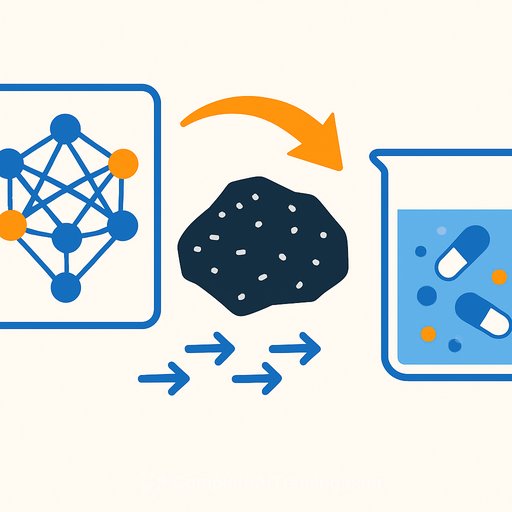
Scientists compiled data from dozens of previous studies, capturing 16 key variables about biochar properties, chemical composition, and experimental conditions. They trained several machine learning models to predict reaction rate constants, the metric that indicates how quickly antibiotics degrade.
A transformer-based algorithm called TabPFN outperformed other models, achieving an R² value of approximately 0.91 with low error rates. This precision allows researchers to estimate degradation efficiency across scenarios without running each experiment.
What Drives Performance
The model identified persistent free radicals-formed during biochar production-as the dominant factor in degradation speed. These radicals generate reactive oxygen species that break down antibiotic molecules.
Other significant contributors included pore volume, oxidant concentration, and pollutant levels. The analysis revealed that optimal performance requires balance: moderate oxidant concentrations enhance degradation, while excessive amounts trigger side reactions that reduce efficiency.
Practical Application
Researchers built a web-based tool where users input experimental parameters and receive instant reaction rate predictions. This platform enables rapid screening of new biochar materials without extensive lab work.
The framework extends beyond antibiotics. It can be adapted to study other environmental pollutants and catalytic systems, providing a general method for combining data science with environmental engineering.
As antibiotic pollution continues to contaminate ecosystems, this approach accelerates the development of treatment solutions. The work demonstrates how machine learning can guide material design when traditional optimization methods prove too slow or costly.
Learn more: AI for Science & Research
Your membership also unlocks: