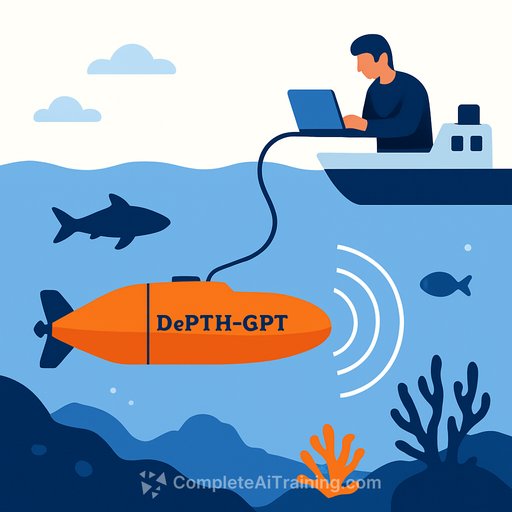
DePTH-GPT launches: Deep-sea AI to boost ocean research
A collaborative team led by Chinese scientists has launched DePTH-GPT, a deep-sea exploration AI model built to push ocean science into a more intelligent, interpretable, and predictive phase. The effort sits within the Digital DEPTH project under the United Nations Decade of Ocean Science for Sustainable Development, signaling broader support for ocean data infrastructure and open collaboration.
The model integrates deep learning, large language models, computer vision, and knowledge reasoning to process multi-source data: video footage, topography, hydrodynamics, sediment, and bioacoustics. The goal is simple-cut the lag between data collection and insight, and make results easier to validate and reuse across teams.
What DePTH-GPT brings together
- AI stack: deep learning, large language models, computer vision, and reasoning.
- Data modalities: ROV/AUV video, seafloor terrain, currents and flow fields, sediment profiles, and acoustic signals.
- Intended outputs: interpretable analyses and predictive insights that can be audited and transferred across sites.
Early results
The team reports an intelligent cognitive system already established for a deep-sea seamount and a hydrothermal vent field. That's a strong test bed for multi-modal fusion, given the complex structure of seamount habitats and the dynamic chemistry and acoustics around vents.
If you need a quick refresher on vent ecology and why it's a tough benchmark for automation, see NOAA's overview of hydrothermal vents here.
Why this matters for research teams
- Video-first workflows: faster annotation, organism/feature detection, and event flagging to reduce post-cruise backlogs.
- Habitat mapping: consistent labeling across expeditions, with links between terrain, sediment, and observed biota.
- Bioacoustics: automated classification and cross-checks with visual detections for validation.
- Predictive modeling: scenario testing for plume spread, habitat change, or likely species occurrence given local conditions.
- Knowledge transfer: models that can be adapted across regions with transparent reasoning steps and uncertainty estimates.
Access and next steps
According to project statements, DePTH-GPT will be made available to global research institutions and international organizations. The plan is to expand intelligent cognitive systems across key deep-sea habitats including seamounts, hydrothermal vents, abyssal plains, and continental slopes.
That availability matters. Shared tooling and comparable outputs make it easier to pool datasets, verify findings, and inform governance decisions that depend on consistent evidence chains.
Practical notes for labs planning evaluations
- Data standards: align inputs/outputs with widely used formats and FAIR principles to keep results reusable.
- Label taxonomies: define organism, feature, and habitat labels upfront; document versioning to avoid drift.
- Validation: compare model outputs with expert annotations; report uncertainty and confidence intervals.
- Generalization: test across regions, depths, seasons, and sensor types to check domain shifts.
- Governance: set review workflows for model updates, and document decision criteria for management use.
- Compute and energy: plan for training/inference costs and shipboard/offline modes if bandwidth is limited.
Learn more
Explore the UN Decade of Ocean Science initiatives here. For teams leveling up skills in LLMs, computer vision, and multimodal pipelines, browse curated programs at Complete AI Training.
Bottom line: DePTH-GPT points to a practical future for ocean science-multi-modal data in, interpretable and testable insights out. If your lab works with ROV video, bathymetry, or acoustics, it's worth preparing your datasets and benchmarks so you can evaluate systems like this the moment access opens.
Your membership also unlocks: