DeepCura Operates With Two Humans and Seven AI Agents
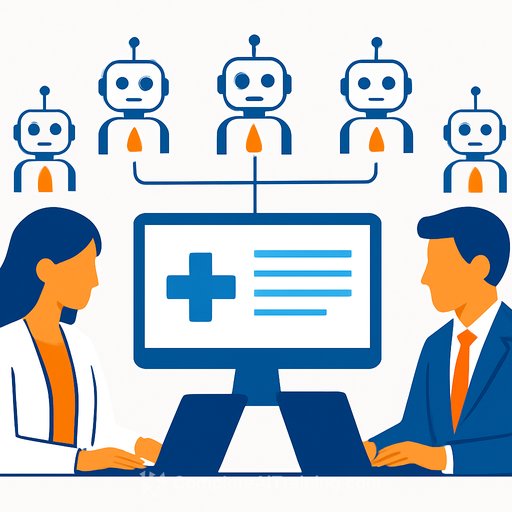
DeepCura, a clinical AI platform serving 6,000 clinicians across 50+ medical specialties, runs with a skeleton crew: two human employees and seven autonomous AI agents. The agents handle customer onboarding, clinical documentation, sales calls, and billing. Approximately 80 percent of the organization's operational workforce is artificial intelligence.
This staffing structure reflects a deliberate architectural choice, not a cost-cutting experiment. The decision has direct implications for how the platform integrates with hospital systems, secures patient data, and improves over time.
How Agentic Native Architecture Works
Most healthcare AI vendors follow a predictable pattern: build a traditional software company, then add AI features. Sales, support, and implementation run on human labor. DeepCura inverted this model.
The platform was designed so that the same AI agents sold to clinicians also run the company's internal operations. Seven interconnected agents form the operational backbone:
- Emily, the onboarding agent, conducts voice-first setup conversations using medical-grade speech recognition. A clinician can call, speak to Emily, and have an entire clinical workspace-AI scribe, phone system, scheduling, billing-configured in a single conversation. No implementation team. No multi-week deployment.
- The AI Receptionist Builder constructs the practice's phone system, including call scripts, knowledge base, voice selection, emergency routing, and multilingual support.
- The AI Scribe runs five AI engines simultaneously-OpenAI GPT-5, Anthropic Claude, and Google Gemini-presenting clinicians with side-by-side documentation outputs so they can select the most accurate note for each encounter.
- The AI Nurse Copilot handles pre-visit patient intake.
- AI Billing automates invoicing and payment collection via SMS.
- The Company Receptionist answers DeepCura's own sales and support calls.
Continuous Improvement as an Architectural Feature
Running company operations on the same agents sold to customers creates automatic feedback loops. When DeepCura improves its documentation engine for internal use, every customer's AI scribe improves simultaneously. When the onboarding agent learns from a new edge case, that learning propagates across the entire network automatically.
Traditional software companies ship updates on quarterly cycles. DeepCura improves continuously because agents learn from interactions across the full customer base. This compounds over time.
Integration and Security Standards
The platform maintains bidirectional FHIR write-back to seven EHR systems: Epic, athenahealth, eClinicalWorks, AdvancedMD, and Veradigm. Clinical notes generated by the AI scribe write directly back to the patient chart, eliminating the copy-paste workflow that costs clinicians an estimated 15 to 30 minutes per encounter.
DeepCura completed Google's CASA Tier 2 security assessment-the same standard applied to applications handling sensitive data for millions of users-and maintains full HIPAA compliance with BAA availability for all practices. The platform runs on AWS infrastructure designed for autonomous operation with no single point of failure.
What Clinicians Are Looking For
In an analysis of Reddit discussions across medical communities, clinicians evaluating AI scribe tools consistently identified two deciding factors: depth of EHR integration and pricing transparency.
Agentic native architecture produces structural advantages in both areas. Deeper integration occurs because the agents themselves use the same FHIR connections. Lower pricing results because operational costs are a fraction of traditional vendors, which charge $300 to $1,000 per provider per month. DeepCura starts at $129 per month.
The Broader Pattern
This dynamic has played out in other industries. Companies born on the internet displaced companies that moved their catalogs online. Companies born in the cloud displaced companies that migrated data centers. The same shift is now emerging in AI for Healthcare: platforms that are agentic native-where AI agents form the operating system rather than a feature layer-will deliver fundamentally different economics, reliability, and speed of improvement than legacy architectures with AI bolted on.
DeepCura is bootstrapped and profitable. It serves as a proof point for a thesis that extends beyond healthcare: small teams amplified by networks of specialized AI agents will outperform traditionally staffed organizations.
Your membership also unlocks: