Google DeepMind and the UK: The First Automated AI Science Lab
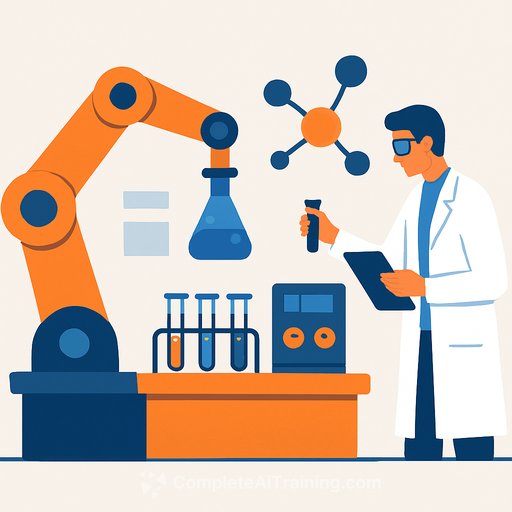
Google DeepMind and the UK government are launching an automated materials science lab in Britain, opening in 2026. The facility will combine the Gemini model with robotics to synthesize and test hundreds of candidate materials per day. The goal is simple: shorten the distance from hypothesis to working material.
What the lab will do
The lab is being built for tight integration with Gemini, handling text, images and multimodal data from instruments and experiments. A multidisciplinary team will run high-throughput synthesis and testing loops, using AI to plan experiments and refine results in near real time.
Potential impact spans superconductors at ambient conditions (reducing energy loss in transmission), improved solar cells, better medical imaging agents and new materials for more efficient chips and batteries. The setup aims to turn "what if" into "tested today" across hundreds of iterations.
AI systems UK researchers will access
- AlphaEvolve: a Gemini-powered coding agent for designing advanced algorithms.
- AlphaGenome: assists scientists in understanding DNA and genomic relationships.
- AI co-scientist: a multi-agent collaborator for study design, analysis and literature grounding.
- WeatherNext: a family of state-of-the-art weather forecasting models.
This builds on AlphaFold, already used by 190,000 UK researchers to study areas from antimicrobial resistance to crop resilience. For reference, see the AlphaFold Protein Structure Database for structures and coverage data: alphafold.ebi.ac.uk.
Why this matters for scientific throughput
Integrated AI + robotics can compress years of trial-and-error into months. Materials pipelines benefit the most: you can evaluate larger search spaces, prioritize feasible candidates and quickly discard dead ends. For research groups, that means more validated leads and cleaner datasets, not just faster papers.
Education and skills
Early trials show clear time savings in education. In Northern Ireland, teachers using Gemini for admin and lesson planning via the Education Authority's C2k system saved an average of 10 hours per week. Separate research by Eedi found students taught by teachers using AI tools were 5.5% more likely to solve problems on new topics.
If you're leading a lab or department, that's a signal: workflows that offload routine tasks free staff for higher-value thinking. For structured upskilling, see AI course paths by job role: Complete AI Training - Courses by Job.
Public sector experiments
The government's AI Incubator team is piloting Extract, which uses Gemini to convert planning documents into structured data. Tasks that can take up to two hours per document are processed in around 40 seconds. This could materially speed up decision timelines for council planners.
Safety, security and reliability
DeepMind will deepen collaboration with the UK AI Safety Institute on explainability and alignment research. Details of the institute's remit are available here: UK AI Safety Institute.
Cybersecurity work is also in scope, including Big Sleep and CodeMender-tools that can surface software vulnerabilities and apply automatic code repair. For research software engineering teams, this points to tighter CI pipelines with AI-in-the-loop testing and remediation.
What leaders are saying
"AI has incredible potential to drive a new era of scientific discovery and improve everyday life," says Demis Hassabis, CEO and Co-founder of Google DeepMind. "We're excited to deepen our collaboration with the UK government and build on the country's rich heritage of innovation to advance science, strengthen security - and deliver tangible improvements for citizens."
Liz Kendall, UK Technology Secretary, adds: "DeepMind serves as the perfect example of what UK-US tech collaboration can deliver... This agreement could help to unlock cleaner energy, smarter public services and new opportunities which will benefit communities up and down the country."
How researchers can act now
- Audit where AI copilots can reduce cycle time: literature review, experiment planning, code generation and data wrangling.
- Prepare your data foundations: clean schemas, clear metadata, and reproducible pipelines for faster integration with AI systems.
- Set up small, low-risk pilots using AlphaEvolve or the AI co-scientist to validate value before scaling.
- For materials teams, map a closed-loop experiment plan (design-synthesize-test-analyze) and identify steps ready for automation.
- Engage with institutional security teams early if you plan to trial Big Sleep or CodeMender on production codebases.
The bottom line
This partnership links AI research, automated experimentation and public sector delivery under one umbrella. For UK scientists, it means priority access to high-impact tools-and a practical path to faster discovery with stronger guardrails. The labs that move first on data quality, workflow automation and skills will benefit most when the facility comes online in 2026.
Your membership also unlocks: