
AI news ·
Defense Department and industry debate AI guardrails for military use
The Defense Department must add "any lawful use" language to AI contracts within 180 days. This mandate drops usage limits, sparking intense debate over AI guardrails.
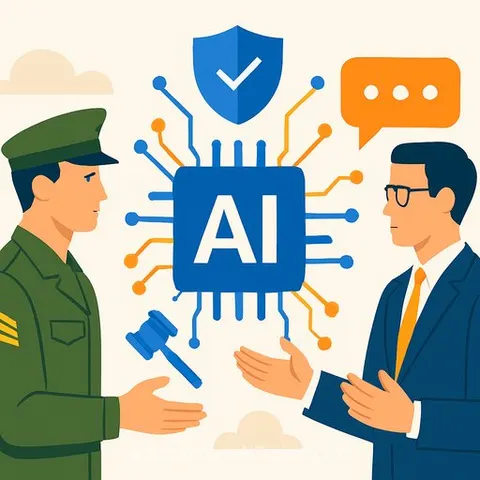
Secretary of War Pete Hegseth issued a memo on Jan. 9 directing the Defense Department to procure artificial intelligence models without usage policy constraints that could limit lawful military applications. This mandate requires adding any lawful use language to military AI contracts within 180 days, sparking intense debate between government leaders and private tech companies over the removal of AI guardrails.
Industry and intelligence clash over control
Private companies now possess advanced AI capabilities that raise significant security concerns. Garrett Berntsen, chief AI officer at Accenture Federal Services, noted during an April panel that "we basically have private companies that have technology that could break into the NSA." He compared this dynamic to private industry building nuclear weapons in the 1940s without government oversight.
However, intelligence leaders resist letting tech firms dictate how these tools are deployed. CIA Deputy Director Michael Ellis said in a keynote address that the agency cannot be controlled by the preferences of a single vendor. "We should not fall into the trap of thinking that a single company possesses a significant advantage over others when AI technology is evolving so rapidly, and numerous new options - in particular, open-source models - are entering the field," Ellis said.
Anthropic supply chain dispute highlights the friction
This policy tension escalated in early March when the Defense Department designated AI company Anthropic as a supply chain risk, barring it from military contracts. Anthropic co-founder and CEO Dario Amodei stated the designation resulted from the company raising concerns about the Pentagon using its systems for fully autonomous weapons and mass domestic surveillance.
Anthropic is challenging the decision in federal court. The D.C. Circuit Court of Appeals denied the company's request for a temporary block on the designation in April but granted expedited consideration, scheduling oral arguments for May 19.
Healthcare and operational risks demand balance
While some officials argue guardrails hinder mission effectiveness, others warn that removing them creates severe downstream risks. Pete Walker, chief innovation officer at IntelliGenesis, pointed to military healthcare as a critical area requiring safeguards. Training an AI model exclusively on data from one demographic, such as Caucasian males, maximizes raw efficacy but fails when applied to diverse populations.
Walker warned that without boundary conditions, an AI tool for diagnosing post-traumatic stress disorder could misidentify symptoms in underrepresented groups. This creates ethical conflicts for military physicians bound by the Hippocratic Oath. "You are going to probably see providers that are going to say, 'If that is actually the policy, am I willing to come in and serve as a healthcare provider in the United States military when I know that I may be forced to make these decisions, patient first or policy first?'" Walker said.
Despite these policy disagreements, military leaders emphasize the necessity of adoption. Army Brig. Gen. David Elsen, Indo-Pacific Command's director for intelligence, stated that the "operational risk of not using AI outweighs the security risk of using AI." OpenAI's head of national security policy, Sasha Baker, echoed this urgency, noting that if adversaries access advanced capabilities through open-source models, the U.S. government must possess equivalent tools for defense.
The ongoing debate surrounding AI for Government centers on how agencies can adopt these tools without compromising security or ethical standards. For officials drafting procurement rules, the challenge of balancing technological adoption with necessary oversight remains a core focus for AI for Policy Makers.
Why this matters for government professionals
Government professionals must prepare for a contracting environment where "any lawful use" becomes the standard for AI procurement. You will need to evaluate vendor proposals not just for technical capability, but for how their models perform across diverse populations. Assess whether the removal of guardrails introduces unacceptable liability or ethical risks in your specific mission area before signing off on new deployments.