
AI news ·
Delaware chancery court warns lawyers about AI hallucinations in court filings
A Delaware court warned that AI hallucinations in filings can trigger Rule 11 sanctions, citing a case where a brief contained fabricated citations and legal propositions. The lawyer and firm face potential joint liability after failing to fully correct errors in a revised filing.
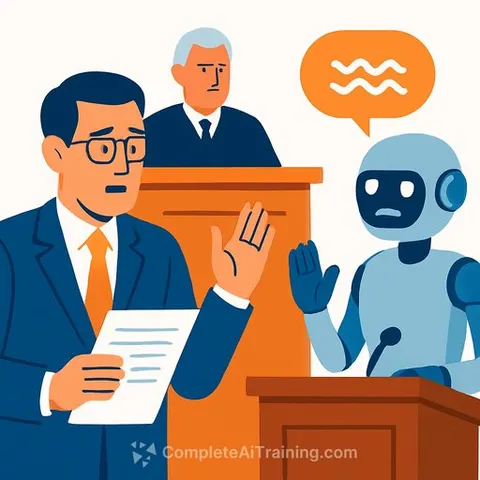
A recent Delaware Court of Chancery decision provides a stark warning for litigators: AI hallucinations in court filings can trigger sanctions under Rule 11, even if the underlying legal argument wins.
In *Leiske v. Kidd*, C.A. No. 2025-0426-CDW (LWW) (Del. Ch. July 1, 2026), Vice Chancellor Lori W. Will addressed a brief containing "fictitious citations, fabricated quotations, and hallucinated legal propositions." The court found that the responding party's initial filing, and a corrected version that failed to fix the errors, raised an inference of a Rule 11(b) violation.
How the court handled the hallucinated citations
The problem began when an answering brief cited cases and legal propositions that did not exist - classic GenAI hallucinations. The court said using AI in filings is "not inherently problematic," but the consequences multiply when lawyers fail to verify the output before filing.
The situation grew worse. When the filing party corrected the brief, according to the court, the corrected version did not fix all of the invented law or mischaracterizations of actual cases. Instead, it removed the quotation marks and "attributed the problem to a paralegal's review," the court wrote.
After the errors were pointed out, the lawyer who originally filed the brief doubled down, insisting on "the accuracy of the underlying legal propositions" and accusing opposing counsel of "using the GenAI errors to gain a litigation advantage," according to the opinion.
Rule 11 and the sanctions procedure
The court analyzed the case under Court of Chancery Rule 11(b), which requires that a lawyer presenting a pleading certify that "the legal contentions made are warranted by existing law." A lawyer's signature on a filing is a certification to the court.
Under Rule 11(c)(1), the responsible lawyer-and the law firm-may be held jointly liable for violations by its partners, associates or employees.
The court required both the individual lawyer and his firm to confirm that they followed written GenAI policies. The next step is a final decision on sanctions after the court receives the required affidavits.
What to do when AI errors are discovered
The court laid out three steps for lawyers who discover GenAI mistakes in their court filings:
1.
Notify the court promptly and submit a fully corrected version as soon as possible. 2.
Take full responsibility for the mistake, not an assistant or paralegal. 3.
Explain exactly how the error occurred and what steps the firm has taken to prevent it from happening again.
The ruling emphasized that the response after the error was found-a defense of the original work and an attempt to blame a junior-only compounded the problem.
Why this matters for legal professionals
For in-house counsel, outside attorneys, and litigation teams using GenAI tools, this case shows that a well-intentioned but unverified AI-generated brief can spiral into a separate sanctions hearing. The court is not punishing the use of the technology; it is punishing the failure to verify the output before filing and the attempt to evade responsibility afterward. The same technology that speeds up legal research can, if lawyers skip verification, turn a winning case into a lesson on Rule 11.
For those looking to stay ahead of these issues, understanding how to safely integrate AI for Legal tasks is becoming a core competency for any firm that wants to avoid the sanction track.