CEO's ChatGPT Queries Become Evidence in Delaware Breach of Contract Case
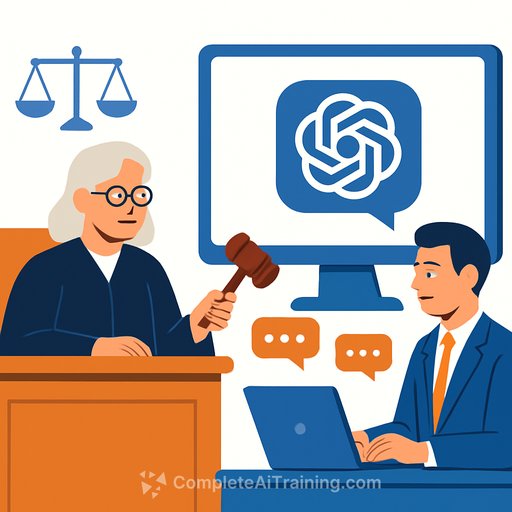
A Delaware court has ruled that a CEO's ChatGPT conversations constitute discoverable evidence in a contract dispute, establishing his motive to breach an earnout agreement and demonstrating pretext for firing key employees. In Fortis Advisors, LLC v. Krafton, Inc., Vice Chancellor Lori W. Will relied on the CEO's chat logs to find liability and grant equitable relief, signaling that AI interactions now carry the same evidentiary weight as email and messaging records.
Krafton, Inc. acquired Unknown Worlds Entertainment, a video game studio, with an agreement guaranteeing the founders-Charlie Cleveland, Max McGuire, and Ted Gill-significant earnout payments and operational control. Concerned the earnout reflected a poor deal, Krafton CEO CH Kim sought advice from ChatGPT on avoiding payment after in-house counsel warned against it.
Kim's queries asked the chatbot to clarify whether the earnout was cancellable and to suggest negotiation tactics. ChatGPT outlined pressure strategies and talking points. At the chatbot's suggestion, Kim created "Project X," an internal task force tasked with either negotiating down the earnout or executing a "Take Over" of the studio. Krafton followed most of ChatGPT's recommendations over the following month.
Krafton then terminated the three founders, claiming "intentional acts of dishonesty." The founders sued for breach of contract. The court's evidentiary record included emails, Slack messages, and ChatGPT queries. The CEO had shared his ChatGPT outputs via Slack with colleagues, which meant privilege was never asserted and the chat logs became fair game in discovery.
The court quoted ChatGPT's responses directly and matched them against Krafton's subsequent actions. The evidence demonstrated the terminations lacked legitimate basis and were pretextual. Krafton was held liable. The court reinstated Gill as CEO, restored operational control to the founders, and extended the earnout period by 258 days. A second trial phase will determine monetary damages.
Privilege and Work-Product Protection Remain Unsettled
The CEO's conversations with ChatGPT might have been privileged had he been consulting a lawyer. They could have been work product prepared in anticipation of litigation. Neither argument succeeded in Krafton because Kim had voluntarily disclosed the substance of his AI conversations to non-lawyers via Slack, waiving any privilege claim.
Kim had also deleted his original ChatGPT search histories before litigation was reasonably anticipated. Fortis moved to compel the original queries, but Krafton confirmed they no longer existed. The court never issued a published ruling on whether the original queries would have been discoverable had they been preserved.
The case is part of a broader pattern. Recent federal court decisions have reached conflicting conclusions on AI and privilege.
In U.S. v. Heppner (S.D.N.Y., February 2026), a defendant's use of consumer-tier Claude to outline defense strategies received no privilege protection, with the court finding no reasonable expectation of confidentiality given the platform's terms.
In Warner v. Gilbarco Inc. (E.D. Mich., February 2026), by contrast, the court denied a motion to compel AI interactions and criticized the request as a "fishing expedition." The court stated that work-product protection is not waived merely by using ChatGPT as a tool, since "the information wasn't disclosed to an adversary or in a way likely to get in an adversary's hand."
In Morgan v. V2X, Inc. (D. Colo., March 2026), the court extended work-product protection to a pro se litigant's AI interactions but imposed strict requirements: Data Processing Agreements must prohibit vendor training on inputs, bar third-party disclosure, and guarantee deletion on demand. The court acknowledged these requirements would effectively bar parties from using most mainstream low-cost AI tools for confidential information.
Most recently, in Tate Group Automotive LLC v. Legacy Automotive Capital LLC (Tex. Bus. Ct., June 2026), a Texas court ruled that certain ChatGPT conversations were protected as work product, finding AI-assisted document review analogous to using Westlaw or LexisNexis. The court ordered disclosure of all discovery materials shared with ChatGPT and recommended parties amend protective orders to address AI tool usage.
What Executives Need to Do Now
Update document retention policies to address AI tools. Understand how different platforms save or delete queries and outputs. When litigation is anticipated, issue litigation holds that specifically cover AI prompts, queries, responses, and AI-generated drafts-including enterprise-embedded functions like Microsoft 365 Copilot, Google Workspace AI, and Slack AI.
Hold memos should instruct custodians to disable auto-delete features within AI platforms and preserve custom instructions and system prompts. They should also require disclosure of any personal or non-enterprise AI accounts touching the matter. Shadow IT poses particular risk: senior executives running personal AI accounts on personal devices often operate with retention defaults the company has never seen. Consumer-tier platforms may default to rolling 30-day deletion of temporary chats.
Conduct an AI audit early in any matter kickoff. Identify which tools are in use, by which custodians, on which devices, with which retention defaults. Have that conversation before or at the same time as sending preservation notices.
Implement AI governance policies across the organization. Policies, procedures, training, and oversight for AI tool selection and deployment reduce legal, operational, and reputational risk. As Krafton illustrates, even a CEO can deploy an AI-generated strategy that contradicts counsel's advice and creates significant litigation exposure. Governance programs should integrate with existing compliance and training programs applicable from the C-suite to any user of an AI tool.
The Real Risk: Business Decisions Based on AI Advice
The central lesson from Krafton: business decisionmakers should avoid asking AI for advice on decisions that pose legal risk, particularly in organizations with in-house counsel. Here, the CEO's chat logs involved two obvious legal risks-employment termination and breach of contract.
AI can spot issues but it is not a responsible advisor. If you ask a chatbot "how do I get out of this payment obligation?" it will still offer suggestions even if it warns against the approach. AI systems tend toward helpfulness and validation. Even asking something more benign-"do we have to pay this earnout?" or "can we terminate these employees?"-creates risk. Any subsequent deviation from that interpretation may appear knowing and willful.
In-house lawyers might warn their leaders: imagine being deposed on your chat logs. The ubiquity of AI assistants and pressure to move quickly may overpower lawyers who simply say "don't." Consider these safeguards: consult AI only with a lawyer's oversight or assistance; use temporary chat (subject to litigation holds); mark the chat privileged and confidential. None of these matter if AI "advice" is circulated among non-lawyers internally.
The introduction of AI compounds the risk that what previously would have been limited to privileged attorney interactions and thought processes on risk-based decisions will now be fully discoverable and damaging. Train corporate decisionmakers and HR on the importance and applicability of evidentiary privileges, with special attention to the AI intersection.
Consider consulting the AI for Legal resource for deeper guidance on privilege and discovery issues. Executives may also benefit from the AI Learning Path for CEOs, which addresses AI governance, decision-making risks, and strategic implementation for C-suite leaders.
Your membership also unlocks: