Deloitte expands Nvidia partnership to push physical AI into real factories
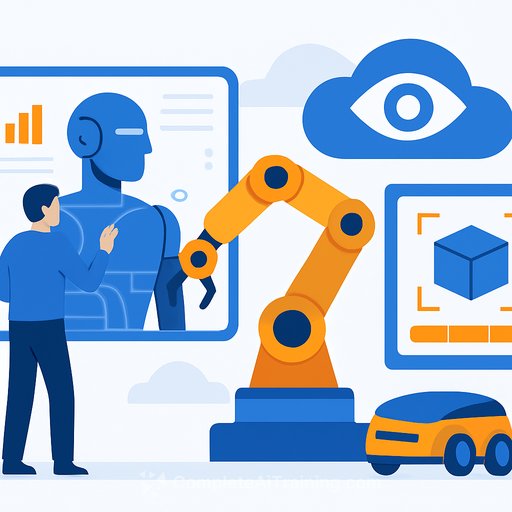
Deloitte is deepening its work with Nvidia to move physical AI from lab demos to production on the shop floor. The focus: digital twins, computer vision, edge computing and robotics-built on Nvidia's AI and simulation stack and paired with Deloitte's engineering and industry teams.
Solutions will use Nvidia Omniverse libraries to simulate operations, read real environments and ship intelligent machines into production. The goal is simple: shorten the path from prototype to a working system you can maintain and scale.
From pilots to production
Physical AI is crossing the line from trials to day-to-day work in manufacturing, automotive and life sciences. As Nitin Mittal put it, this shift is changing how work gets done-fast.
Deloitte's latest State of AI in the Enterprise says 58% of companies already use physical AI in some form, with 80% expected within two years. These systems blend perception, reasoning and action to run robots, autonomous vehicles and sensor-driven operations.
What's in the stack
Simulation-based planning: Digital twins built on Nvidia Omniverse let teams model lines, cells and warehouses before changing anything in the real plant. Deloitte is already working with automotive clients to tune layouts, scheduling and material flow in virtual space to cut downtime and speed changeovers.
Edge robotics deployment: Deloitte is building with Nvidia Isaac Sim and Nvidia Cosmos world foundation models, and targeting hardware like Nvidia Jetson Thor. In life sciences, they're combining simulation, synthetic data, teleoperation and sim-to-real validation to stand up humanoid robotic systems with predictable behavior.
Computer vision: Using Nvidia Metropolis and Blueprint for video search and summarization, Deloitte is shipping use cases that inspect assets, spot anomalies and forecast failures.
Proof on the floor: HORSE Powertrain's kAIros
In Valladolid, Spain, Deloitte helped HORSE Powertrain roll out anomaly detection to predict equipment faults and improve inspections as part of its kAIros efficiency program. "By combining on-premise supercomputing with Nvidia technology, we have created an ecosystem capable of deploying real-world use cases across all our departments," said Patrice Haettel.
Why it matters for IT and development teams
Two things are converging: higher-fidelity simulation and reliable edge AI. That combo means fewer blind spots, safer rollouts and quicker iteration. As Deepu Talla noted, full-stack physical AI plus industry know-how gives enterprises a path to move from exploration to scaled deployment-using simulation to de-risk the hard parts.
Practical build notes (so you can ship)
- Start with a digital twin: Model a single line or cell in Nvidia Omniverse. Mirror signals from PLC/SCADA via OPC UA or MQTT. Keep a consistent tag schema and units from day one.
- Close the sim-to-real gap: Train and validate policies in Isaac Sim. Use domain randomization, hardware-in-the-loop, and staged rollouts (shadow mode → gated control → full control).
- Make edge a first-class citizen: Target Jetson Thor-class devices. Containerize. Prefer k3s/Kubernetes for rollouts, OTA updates, and health checks. Plan for offline-first operation and local decisioning.
- Computer vision that scales: Standardize video ingestion, frame sampling and labeling. Use Metropolis/Blueprint pipelines for search, summaries and anomaly alerts. Track false positive/negative rates per asset.
- Observability and MLOps: Log every inference with context (model hash, sensor, firmware). Automate model promotion gates with real-world performance thresholds. Keep synthetic data sets versioned and reproducible.
- Security and safety: Use signed containers, SBOMs and role-based access. Isolate safety-critical paths. Define fallbacks and manual override for every autonomous action.
- Tie into operations: Connect the twin to MES/ERP for work orders and inventory signals. Push events, not batches, for faster decisions. Measure OEE lift, MTTR, FP/FN rates and energy per unit.
Early results and where this goes
Teams report fewer unplanned stops and faster decision cycles when they pair simulation-led testing with secure edge AI. That's the pattern Deloitte is scaling via a global network of physical AI centers of excellence, including a new site in Shanghai focused on robotics and manufacturing automation. The centers are built to help clients move from prototype to production while meeting regulatory and security requirements.
Key takeaways for builders
- Use digital twins to de-risk changes before you touch the line.
- Adopt a standardized edge stack you can support across plants.
- Design for observability and rollback from day one.
- Prove value on a narrow slice (one cell, one camera stream), then scale.
Resources
- Nvidia Omniverse - interoperable platform for building and operating digital twins.
- Nvidia Isaac Sim - simulation for robotics development and validation.
- AI for IT & Development - practical training and updates for developers and IT teams building AI systems.
Your membership also unlocks: