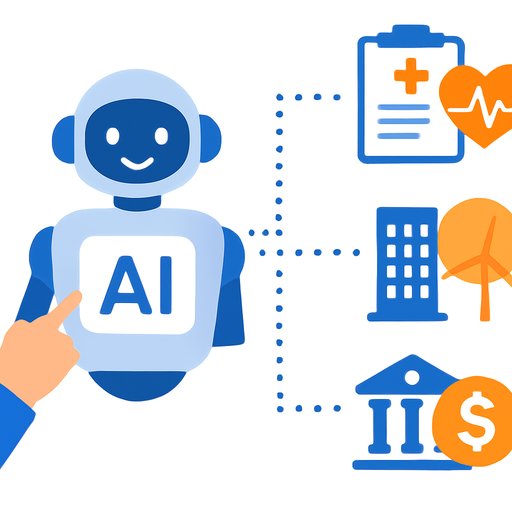
How OpenTI Is Driving Enterprise AI Adoption Across Healthcare, Energy, and Finance
AI is finally delivering real operational gains - without a year of custom builds. OpenTI brings pre-configured, deployable AI agents that plug into existing workflows and start producing outcomes in days or weeks.
For healthcare leaders, that means less admin waste, fewer denials, faster reimbursements, and staff freed up to do meaningful work. The model fits regulated environments and keeps data ownership where it belongs - with you.
Why this matters for healthcare right now
Denied claims drain time and cash. Nearly half of U.S. providers see denial rates above 10%, and averages have risen from ~9.6% to ~12% in recent years.
AI used in billing and documentation has shown strong wins: up to 50% faster claims processing, automation across most denial workflows, and 30%+ staff productivity gains. Many providers also report fewer denials and healthier cash flow after adopting AI-driven workflows.
What OpenTI's healthcare agents do
- Claims validation: Pre-submission checks against payer policies and historical patterns to reduce avoidable edits and rework.
- Coding automation: Structured data extraction from notes and attachments to support accurate coding and cleaner claims.
- Real-time documentation QA: Flags missing elements, contradictions, or medical necessity gaps before a claim ever goes out.
- Denial management support: Intake, triage, and draft responses for common denial reasons, with human review where needed.
Results you can expect in weeks
- Higher first-pass acceptance and fewer appeals.
- Shorter days in A/R and faster payments.
- Reduced manual touches across coding and RCM queues.
- Happier teams focused on exceptions and patient support instead of repetitive clicks.
Why infrastructure-first beats DIY
OpenTI ships purpose-built agents that integrate quickly, with enterprise controls from day one. No standing up an internal AI lab, no lengthy model training cycles, and no risky data sprawl.
Your organization owns the deployment, data flows, and compliance settings. That's critical for HIPAA alignment, auditability, and clear PHI boundaries. As more agents are deployed, the platform benefits from a data flywheel effect that improves performance - while preserving each client's data governance rules.
A practical rollout plan for hospitals and provider groups
- Pick one high-volume use case: Example: claim edits for top five payers or inpatient coding for two service lines.
- Map data sources: EHR, clearinghouse, payer rules, denial reason codes, and document repositories.
- Baseline KPIs: First-pass yield, denial rate by reason, A/R days, touches per claim, and appeal turnaround.
- Pilot with human-in-the-loop: Start with a narrow queue and require reviewer sign-off. Track precision/recall on edits and coding suggestions.
- Tighten guardrails: Add payer-specific rules, confidence thresholds, and exception routing.
- Integrate and scale: Embed into RCM queues, EHR workflows, and ticketing. Gradually expand to new payers and service lines.
- Govern and monitor: Monthly drift checks, audit logs, and model updates tied to payer policy changes.
Security and compliance essentials
- Clear PHI handling with role-based access, encryption, and audit trails.
- Configurable data residency and retention policies.
- Model behavior monitoring to reduce hallucinations, with retrieval and rules to anchor outputs.
- Documented controls for HIPAA and vendor risk reviews.
What this looks like beyond healthcare
Utilities use AI for forecasting, load balancing, and predictive maintenance to raise reliability and lower Opex. Surveys show broad productivity gains as organizations apply AI to daily operations.
In finance, adoption is further along. Studies report that a large share of companies already use AI in reporting, risk, fraud, and planning, with many seeing returns that meet or beat expectations.
What sets OpenTI apart
- Agent-first platform: Deployable units of work that connect to your systems and deliver outcomes fast.
- Enterprise control: Your data, your policies, your auditability - built for regulated environments.
- Compounding performance: A data flywheel that improves models and playbooks across deployments, without compromising client boundaries.
How healthcare teams can get started this quarter
- Pick one queue with measurable pain (e.g., top denial code family).
- Stand up a 30-60 day pilot with human review and weekly KPI checks.
- Lock in success criteria: first-pass yield + denial reduction + time-to-cash.
- Bake agent outputs into coder and biller workflows; escalate only the edge cases.
- Train your RCM staff on AI-assisted processes. For a focused curriculum, see the AI Learning Path for Medical Billers.
Bottom line
Healthcare doesn't need more pilots. It needs fewer denials, faster cash, and less burnout. OpenTI's plug-and-play agents make that shift practical by delivering results fast, fitting within compliance, and scaling across service lines once the first use case lands.
This is how AI becomes an operational layer - not a science project - for hospitals, health systems, and provider groups.
Your membership also unlocks: