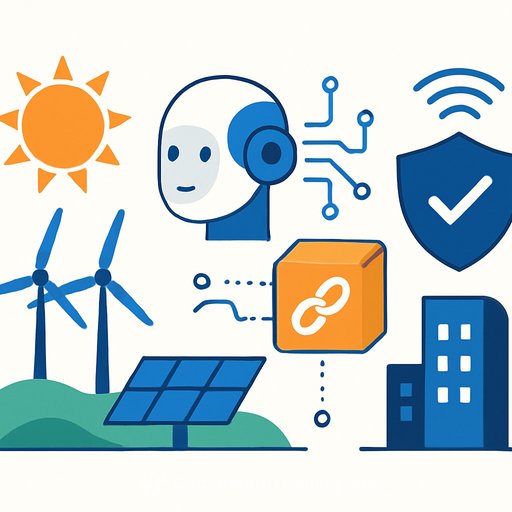
AI and blockchain: The future of renewable energy insurance
2 Feb 2026
Renewables are scaling fast. The International Energy Agency expects global capacity to double between 2025 and 2030. South Africa plans to lift renewables' share of its energy mix from 11% to 41% by decade-end. That growth exposes gaps in traditional cover, making data-led insurtech central to underwriting and claims.
Insurtech meets renewables
"Both sectors are driven by data-led innovation," says Mershalene Maharaj, Underwriting Governance Specialist: Santam Specialist Solutions. "Green energy introduces new-risk categories like solar, wind, and battery storage, while Insurtech provides digital tools using AI, IoT and blockchain to model, monitor, and mitigate those risks." The outcome: cleaner risk signals, leaner loss ratios, and more bankable projects.
- AI: Predictive analytics for component failure, pricing segmentation, and anomaly detection in telemetry.
- IoT: Always-on sensors for vibration, temperature, inverter health, and weather-feeding real-time risk scoring.
- Blockchain: Smart contracts for parametric triggers, tamper-proof logs for audits, and faster settlements.
The risk picture: solar, wind, and storage
- Solar: Hail, windstorm, soiling-related degradation, inverter failures, DC arc faults.
- Wind: Mechanical breakdown, gearbox and blade damage, lightning, crane incidents during O&M.
- Batteries (BESS): Thermal runaway, fire and explosion, smoke damage, contaminated firefighting runoff.
These are high-severity, low-frequency events. Components are interdependent, so a single failure can cascade through the system and the grid connection. That's what makes pricing, limits, and accumulation control so challenging.
Managing African risks
- Infrastructure gaps increase theft and vandalism exposure; spares and long lead times inflate downtime costs.
- Extreme-weather variability affects yield assumptions for solar, wind, and hydro.
- Limited firefighting resources complicate battery incidents and drive higher loss creep.
- Political and regulatory uncertainty adds volatility to project timelines and finance.
From reactive to proactive
IoT-linked sensors and scenario models let insurers spot stress points before failure. "AI-based maintenance can assist in identifying stress points early, reducing uncertainty before failures occur," notes Maharaj. Continuous monitoring shifts insurance from pure loss settlement to loss prevention-cutting severity and improving bankability.
- Predictive maintenance: Vibration and thermography trends flag bearing wear, hot spots, and cable fatigue.
- Parametric and micro-cover: Weather-indexed payouts and micro-insurance expand access for small and off-grid projects.
- Dynamic risk scoring: Telemetry-driven endorsements and incentives for better O&M discipline.
Blockchain: where it fits
- Smart contracts: Automate parametric triggers (hail size, wind speed, lightning strikes) with near-instant payouts.
- Proof and audit: Immutable event logs for SCADA data, maintenance actions, and claims evidence.
- Shared ledgers: Cleaner bordereaux and faster reinsurance recoveries with synchronized exposure and claims data.
- Supply chain provenance: Verifiable component history to reduce counterfeit parts and warranty disputes.
Underwriting and product implications
- Coverage design: Clear carve-outs for degradation vs sudden/accidental loss; battery-specific wording for thermal runaway.
- Deductibles and sublimits: Hail and wind sublimits; outage and delay-in-startup structures tied to lead-time risk.
- Cat and aggregation: Hail corridors, wind fields, and wildfire zones; model site clusters and shared substations.
- Reinsurance: Combine quota share for volatility with XoL for tail events; align parametric layers with reinsurance triggers.
- Pricing: Blend engineering rates with telemetry-adjusted loadings; stress severe but rare loss scenarios.
- Security and fraud: Geofenced assets, tamper alarms, and serial-number tracking to curb theft and false claims.
Data that moves the needle
- Component telemetry: inverter faults, state-of-charge, temperature, vibration, partial discharge.
- Environmental signals: hail size, wind speed, lightning density, wildfire risk, flood depth, dust/soiling index.
- Operational data: O&M schedules, work-at-height logs, fire-suppression maintenance, drone and thermography reports.
- Supply chain metrics: spares inventory, lead times, vendor performance, warranty status.
Why this matters for access to capital
Emerging markets often lack long loss histories. Insurtech narrows that gap with predictive analytics, parametric structures, and continuous monitoring-reducing uncertainty for lenders and investors. Better data makes projects bankable and keeps premiums aligned with true exposure.
Market outlook
Renewable-energy insurance is still under 30% of the fossil-fuel market by premium size. If countries hit stated targets, global renewable energy premiums could exceed $237bn by 2035, according to Swiss Re Institute. That's a major growth lane for carriers, MGAs, and reinsurers focused on data-driven products.
Action checklist for insurance teams
- Stand up a telemetry pipeline (OEM APIs, weather providers, lightning networks) and map fields to pricing and claims.
- Build failure probability models for inverters, gearboxes, and BESS modules; validate with third-party engineering data.
- Launch a parametric pilot in a hail or wind zone; pre-agree data sources and settlement rules.
- Update wordings for battery incidents, salvage, environmental cleanup, and extended BI from long lead times.
- Revisit accumulation controls at substation and corridor levels; align with reinsurance structures.
- Create a battery fire response protocol with local authorities; pre-position resources where feasible.
- Offer premium credits for proven O&M quality, enhanced security, and continuous monitoring.
- Upskill underwriting and claims teams on AI fundamentals and parametric design. For structured learning, see AI Learning Path for Plant Managers, AI for Operations, and AI Learning Path for Supply Chain Managers.
The views expressed and market forecasts referenced are based on external sources and industry trends. They should not be interpreted as guarantees or financial commitments by Santam.
Your membership also unlocks: