DOE offloads parts of emergency operations to AI: what operations leaders need to know
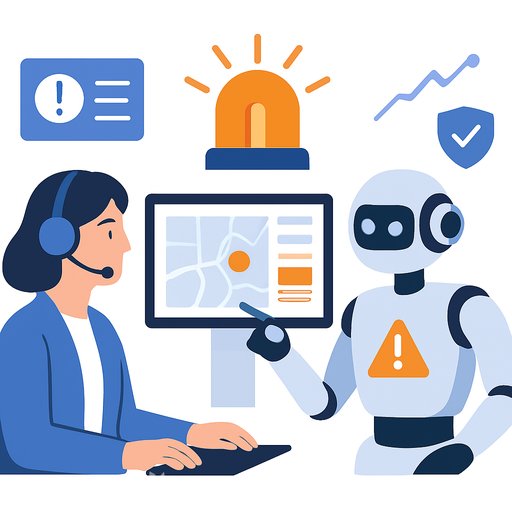
The Department of Energy began shifting pieces of its emergency operations to AI last year, according to its latest inventory of use cases. Using natural language processing, the agency is leveraging a Dataminr tool to surface incident information around National Nuclear Security Administration (NNSA) sites and other DOE locations.
The stated goal: faster reporting and lower cost. The inventory is explicit that the AI is being used in place of a large team that would otherwise code and manage an internal facilitation system.
What changed
- AI deployment began in January 2025 to support emergency operations reporting.
- Tool: NLP-driven alerts and summaries sourced externally, then pushed into DOE workflows.
- Primary promise: speed and efficiency, aligned with federal priorities for AI adoption.
Why this matters for operations
Emergency response is a high-tempo, high-stakes environment. Reducing signal-to-noise latency can shave minutes off triage and coordination. That can mean faster incident confirmation, tighter cross-team communication, and clearer tasking during the first critical hour.
But substituting human effort with AI also shifts risk. You trade manual workload for model quality, vendor reliability, and data transparency. If you run operations, you'll need clear guardrails before expanding similar automations; for governance and strategic oversight, consider targeted training such as the AI Learning Path for CIOs to help define audit trails and human-in-the-loop requirements.
Expert readouts: speed vs. safety
"Using AI to replace human expertise in emergency services can improve efficiency but also introduces serious risks like unclear decision-making, data bias and weakened oversight," said Dia Adams, board chair at The AI Table. Adams called for strong governance: keep humans in the loop, require transparent audit trails, and stress-test models under rare conditions.
Stephen Weymouth of Georgetown University noted the system is designed to augment human expertise, not outright replace it - but warned against leaning on automation before efficacy is proven. Vendor dependence can introduce privacy and security vulnerabilities that only surface under pressure.
Jason Hausenloy of the Center for AI Safety highlighted a longer-term risk: if more decisions are deferred to models built by a small set of companies, power centralizes with those vendors. That has public safety and policy implications that operations leaders should not ignore.
Operational guardrails to implement now
- Human-in-the-loop: define exactly which decisions remain human-owned, with clear fail-stops.
- Transparent audit trails: log prompts, inputs, outputs, timestamps, operators, and model versions.
- Stress tests: simulate rare or adversarial scenarios; measure false positives/negatives under pressure.
- Change management: document model updates, data source changes, and approval checkpoints.
- Vendor diligence: verify uptime SLAs, data handling, security certifications, and breach notification terms.
- Data governance: map data sources, retention, access controls, and PII handling across the toolchain.
- Fallback procedures: define manual reversion, degraded modes, and communication templates.
- Metrics: track time-to-detection, time-to-verification, false alarms, and operator trust scores.
- Training: run tabletop exercises and live "game days" to practice escalation and override paths.
Risk and compliance anchors
DOE's inventory did not detail its risk-mitigation practices for this workflow. That gap is your cue to formalize your own. Align your controls to an established standard like the NIST AI Risk Management Framework to reduce debate and accelerate buy-in.
Document the full lifecycle: problem definition, data sources, model choice, monitoring, and retirement criteria. Then set review cadences and trigger thresholds that force re-evaluation after incidents or notable drift.
Policy and workforce signals to watch
Lawmakers have proposed measures to clarify how AI adoption affects workers and skills, such as the bipartisan AI Workforce Prepare Act and the Workforce of the Future Act. For operations teams, expect more scrutiny on job design, reskilling plans, and how human roles shift as AI takes over routine tasks.
Plan ahead: define the competencies you need (incident analysis, AI oversight, vendor management), then fund training paths and certifications that map to those roles.
A practical rollout plan for ops leaders
Project managers running pilots should adopt structured rollout and change-management practices; a useful reference is the AI Learning Path for Project Managers, which covers rollout planning, KPI definition, and RACI assignments.
- Map decisions: list emergency workflows and flag which steps can be automated without raising risk.
- Tier risk: classify use cases by impact; pilot AI on low-to-medium risk tasks first.
- Define KPIs: speed, accuracy, false alarm rate, and operator workload before/after implementation.
- Set RACI: who monitors outputs, who can override, who owns incident sign-off.
- Integrate: plug outputs into existing tooling (ticketing, paging, comms) with clear metadata.
- Drill: run quarterly simulations, capture findings, and update SOPs.
- Monitor drift: watch model performance by context, time, and incident type; recalibrate often.
- Review quarterly: audit logs, metrics, and incidents; keep minutes and action items.
What to watch next
Expect more federal programs to test AI in time-critical functions. The upside is faster intake and clearer situational awareness. The downside is brittle systems if oversight, vendor controls, and auditability lag behind deployment speed.
Move fast on process, not just tools. If you get the guardrails right, you keep the gains and reduce the downside risk.
Upskilling for operations teams
If you're building AI oversight into emergency or mission-critical workflows, focused training shortens the learning curve. Explore role-specific options here: AI courses by job function.
Your membership also unlocks: