Justice Department Urges Agencies to Use AI for Translations, Limits Multilingual Services
The Department of Justice (DOJ) is pushing federal agencies to scale back multilingual services deemed "non-essential" and to rely on artificial intelligence (AI) when translations are necessary. This move follows a March executive order that declared English the official language of the United States and rolled back earlier policies aimed at expanding access for people with limited English proficiency.
Using AI to Handle Translations
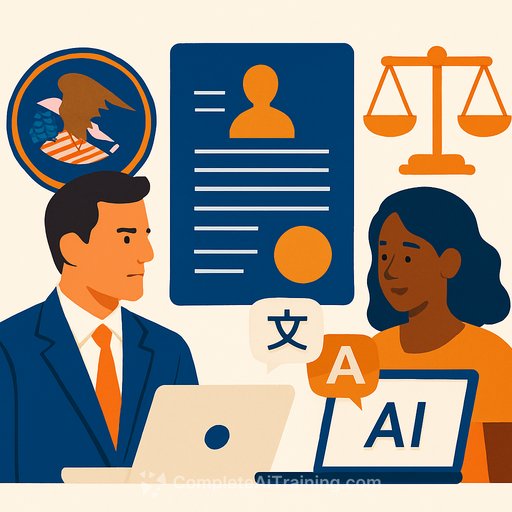
The DOJ's July 14 memo encourages agencies to assess which services could be operated solely in English and to apply AI-assisted translation tools for other cases. The guidance highlights potential cost savings and efficiency gains by integrating AI and machine learning into translation processes. However, it calls for "responsible" AI use without specifying detailed risk mitigation strategies.
Despite the promise of AI, experts caution about its limitations. Sonny Hashmi, an AI specialist with government experience, points out that AI translation accuracy often declines in specialized fields like legal or policy documents. Errors in such contexts could lead to individuals misunderstanding important instructions or missing out on benefits.
To address this, agencies might consider training custom AI models for technical language or ensuring human translators validate AI outputs. The government’s own translation technology guide, hosted on digital.gov, stresses that all machine-generated translations should be reviewed by competent human translators to maintain accuracy.
Amy Holmes, a consultant focused on AI and digital transformation, emphasizes the need for guardrails to ensure translation quality. Similarly, Michael Boyce, who leads generative AI efforts for a civic tech group, highlights the importance of testing and gathering user feedback when deploying AI translation tools. While AI can accelerate translation work and reduce costs, he warns that neglecting proper oversight may create new risks.
Reduction of Multilingual Services
The March executive order does not explicitly require agencies to eliminate non-English products but allows them discretion in offering such services. Attorney General Pam Bondi's memo, however, advises agencies to identify which programs might better serve the public if conducted exclusively in English, within legal limits.
Bondi stated that the DOJ will lead efforts to formalize the executive order and remove what it calls "wasteful virtue-signaling policies" to promote assimilation. The DOJ aims to minimize non-essential multilingual services, and the Department of Government Efficiency has reportedly canceled at least ten language service contracts.
Despite these changes, civil rights laws mandating language access in federally funded programs remain in effect. The DOJ has rescinded prior guidance on language access and plans to issue new instructions soon.
Concerns Over Accessibility
Critics argue that these policies will restrict access to government services for many Americans. According to the Census Bureau, 8.3% of the U.S. population has limited English proficiency. Kica Matos, president of the National Immigration Law Center, warns that reducing multilingual services will make it harder for people to understand essential services like education and health care.
The shift toward AI-assisted translations combined with cuts to multilingual offerings signals a significant change in how the federal government approaches language access. Agencies will need to balance cost and efficiency with accuracy and accessibility to ensure no one is left behind.
Your membership also unlocks: