
AI news ·
Dollar Shave Club uses generative AI to produce July 4 campaign
Dollar Shave Club built its new ad campaign in-house using generative AI in three weeks. The spots promote $2.50 starter kits, one of its largest discounts since 2012.
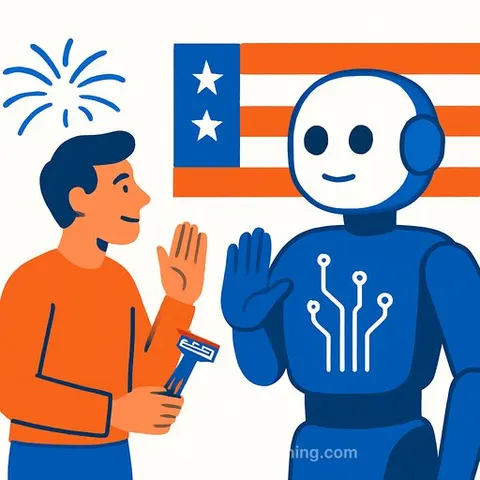
On July 1, Dollar Shave Club launched a "250 Years. No BS. Still Free" campaign built entirely by its in-house team using generative AI. The digital ad spots, which feature hyper-stylized images of American founding fathers rebelling against big razor monopolies, also promote the brand's $2.50 starter kits - one of its largest discounts since launching in 2012. The campaign signals a deliberate shift toward using AI tools to bypass traditional agency models, allowing the creative team to execute faster and keep more work in-house.
Revolutionary imagery produced in weeks
The campaign arrived just days before the July 4 holiday and America's 250th anniversary. Laura Higgins, Dollar Shave Club's chief brand and innovation officer, said the team had nothing planned for the date when she joined a few months earlier. "So I wanted to use AI to bring that 'revolution' theme into a campaign quickly," she said. The team leaned into obvious AI-generated integration of famous paintings - including Washington crossing the Delaware and the Boston Tea Party - with Easter eggs like Dollar Shave Club razors and shave gels hidden in nearly every scene. The entire campaign went from concept to launch in about three weeks, driven by a "very small and scrappy internal agency team."
Human involvement remains central
Higgins said the team uses generative AI strictly as a tool, not a strategy. The creative process began with brainstorming the concept and sequence, then a copywriter built a storyboard in a couple of days using Generative Video tools Claude and Higgsfield AI to produce multiple iterations. "There is still so much human that's involved," Higgins said. "We are using AI as a tool rather than a strategy of trying to trick people into thinking something is real."
Audience reaction and brand voice
Dollar Shave Club has been testing AI-generated ads for six months, with mixed results. The first attempt was a self-aware video that made fun of AI campaigns. A later spot for the brand's electric razor line featured an animatronic Pinocchio who calls himself a "real man" while shaving his wooden body - an ad that received largely positive reactions and leaned into the brand's humorous social media voice. Higgins said the key is leaning into comedy and irreverence. "We want to use AI to be irreverent, funny and to also move faster," she said. "So I do want to continue to lean into that."
Despite the positive reception, the team acknowledges the wider pushback against AI-generated content. Higgins noted that some consumers feel deceived, while brands like Quip have been wrongly accused of posting "AI slop" for ads made without any AI tools. She expects that clearer regulations, such as New York's recent law requiring disclosure of generative AI use in ads, will help brands communicate more transparently with audiences.
Why this matters for creatives
For in-house creative teams, the Dollar Shave Club approach shows that AI for Creatives can strip away the repetitive execution work - storyboarding, iteration, and asset generation - without replacing the human judgment that makes a campaign feel authentic. Jamie Domenici, chief marketing officer at Klaviyo, said the real challenge is knowing your customer deeply enough to keep AI-generated ads relevant and personal. "AI only earns its keep when it closes that gap," she said. The takeaway: speed and cost savings are real, but the brand's voice and the creative team's understanding of the audience remain the non-negotiable core of any successful campaign.