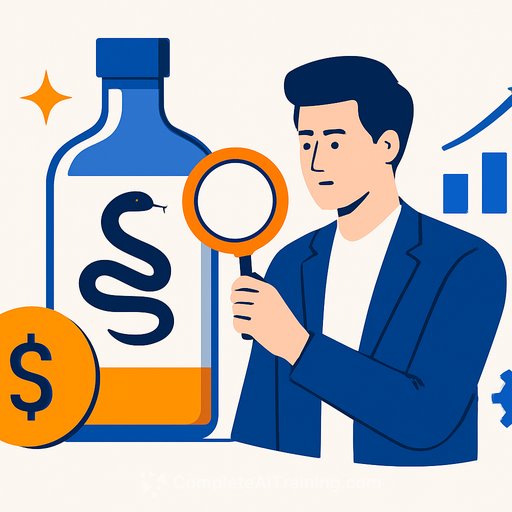
PR needs an AI measurement framework - stop buying snake oil
AI has rewired how people find information, judge credibility, and choose brands. Search results look different, social feeds are filtered by models, and assistants answer questions without a click. That changes what PR influences and how we prove it.
If you're tempted to buy the glossy dashboard with magic scores, pause. You don't need a prettier scoreboard. You need a framework that ties AI-era attention to outcomes your execs care about.
What's changed for PR
- Answers are the new rankings: AI Overviews and assistants summarize sources and decide what gets cited.
- Entities matter more than keywords: models reason about people, brands, and topics as connected graphs.
- Trust signals are machine-read: expertise, citations, and structured data influence what gets surfaced.
- Impact spreads off-platform: screenshots, summaries, and mentions distribute your story without a direct link.
The AI measurement blueprint
Build from first principles. Start simple, keep it honest, and make it testable.
- 1) Objectives: Pick 2-3 business outcomes you can influence: qualified demand, partner interest, hiring pipeline, policy outcomes.
- 2) Audiences & topics: Define priority entities (brand, execs, products) and the 10-20 questions your audience asks before they trust you.
- 3) Indicators: Separate leading vs lagging. Leading = visibility in AI answers, citation quality, creator endorsements. Lagging = direct traffic, demo requests, applications, inbound briefs.
- 4) Data inventory: Map what you already have: web analytics, CRM, media monitoring, social, search console, community platforms, help desk tickets.
- 5) Instrumentation: UTM discipline, event tracking, structured data (Schema.org), newsroom hygiene, spokesperson pages, fact sheets, source PDFs.
- 6) AI visibility tracking: Weekly snapshots of priority questions in AI Overviews and assistants. Log which sources and quotes are cited.
- 7) Quality checks: Score citations by source credibility, freshness, and message accuracy. Track incorrect claims and knowledge panel errors.
- 8) Experiments: A/B headlines, quotes, and explainer snippets. Ship one controlled change per week and watch the indicators.
- 9) Governance: Clear policy for synthetic media, disclosure, and approvals. Document prompts, datasets, and review steps for any AI-assisted output.
- 10) Reporting cadence: Weekly pulse (leading indicators), monthly performance (conversions and cost), quarterly strategy shifts.
AI-era metrics that actually matter
- Share of answers: Percent of priority questions where your brand is cited or quoted inside AI-generated answers.
- Citation quality: Distribution of your mentions across high-authority outlets, subject-matter experts, analysts, and owned sources.
- Entity health: Accuracy and completeness of your knowledge panel and Wikipedia/Wikidata presence; consistency of names, titles, and claims.
- Topic authority: Coverage depth across core themes (explainer pages, FAQs, proof assets, third-party validations).
- Message integrity: Rate of correct vs distorted claims in summaries, reviews, and creator videos.
- Share of search: Branded + category query share over time, segmented by region and audience.
- Path-to-impact: Correlation between AI visibility and downstream actions: direct visits, newsletter signups, trials, RFPs.
Data sources to wire in
- Search & assistants: Regular captures of AI Overviews for your questions; log sources and changes week to week.
- Owned properties: Analytics for newsroom, thought leadership, and resource hubs; event-based goals, not just sessions.
- Media & creators: Traditional coverage plus YouTube, TikTok, LinkedIn creators, podcasts, and newsletters.
- Community & support: Forums, Discord/Slack communities, help desk themes, and feedback forms.
- Knowledge graph signals: Schema markup, Wikidata, industry directories, analyst profiles, and conference bios.
How to pressure-test vendors (and avoid snake oil)
- Ask for ground truth: What labeled data validates their scores? Against what outcomes?
- Look for transparency: Methods, sampling, error bars, and how they handle duplicate or syndicated content.
- Insist on reproducibility: Can you rerun the same query and get the same result with time-stamped evidence?
- Check for bias and safety: How do they detect hallucinations, synthetic media, and spammy citations?
- Reject vanity math: No secret "influence index." Demand plain-language metrics you can explain to finance.
- Pilot first: 6-8 week trial with your questions and your goals. Decide on keep/kill before expanding scope.
A 90-day build plan
- Days 0-30: Lock objectives, audiences, and questions. Audit tracking. Stand up a simple dashboard with your leading indicators and first-party outcomes.
- Days 31-60: Start weekly AI answer captures. Publish two cornerstone explainers and one data-backed proof asset. Run your first message A/B test.
- Days 61-90: Correlate AI visibility with conversions. Prune what doesn't move the needle. Document the playbook and set quarterly targets.
Execution checklist for every PR asset
- Clear headline that answers a real question; one claim per paragraph.
- Source everything: link to studies, standards, or analyst notes; add quotes with credentials.
- Schema markup for articles, FAQs, and person/organization pages.
- Short explainer summary at the top; pull-quote that can be cited.
- Owned proof: data tables, timelines, or how-to steps that others will reference.
Ethics and trust
Disclose AI assistance on owned channels. Keep human review on sensitive topics. Never fabricate data, quotes, or images. Your reputation is a compounding asset-treat it like one.
Recommended references
- AMEC Barcelona Principles for measurement fundamentals and common language.
- Google AI Overviews guidance to understand how summaries and citations show up in search.
Level up your team's skills
Your framework is only as strong as the people running it. Teach prompt craft for research, data literacy for analysis, and editorial judgment for truth and clarity.
Want a structured path? Explore practical courses mapped to job roles here: AI courses by job. For deeper methods and measurement reading, see the AI Research tag.
Bottom line: Build a system that ties AI-era visibility to outcomes and proves it week after week. Buy tools that serve the system-not stories that sell you shortcuts.
Your membership also unlocks: