10,000 Authors Hand Out an "Empty" Book to Push Back on AI Training Without Consent
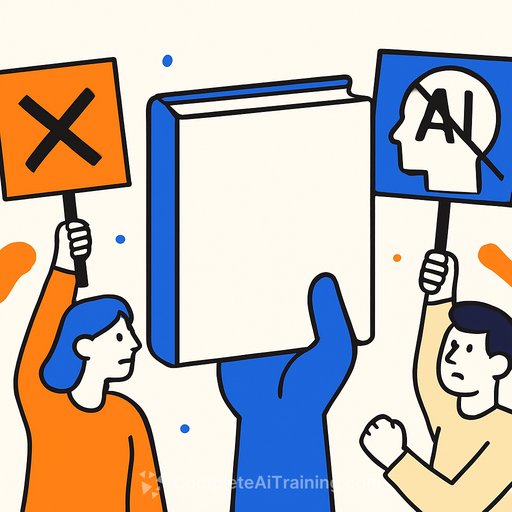
At the London Book Fair, thousands of writers are handing out a book with no content other than a list of their names. The message is blunt: stop training AI on our work without permission or payment. Contributors include Kazuo Ishiguro, Philippa Gregory, Richard Osman, Mick Herron, Marian Keyes, David Olusoga, and Malorie Blackman.
The project, titled "Don't Steal This Book," lands a week before the UK government's 18 March deadline to update parliament on proposed copyright changes. Composer and campaigner Ed Newton-Rex, who organised the effort, says the AI industry is "built on stolen work … taken without permission or payment," adding that generative tools "compete with the people whose work it is trained on."
Why this matters to working writers
AI models are trained on vast datasets that include books scraped from the web or pirated copies. That means your sentences, structure, voice, and ideas can be ingested, then used to produce competing outputs-without a contract, credit, or fee.
Malorie Blackman puts it cleanly: "It is not in any way unreasonable to expect AI companies to pay for the use of authors' books." Most of us agree. The question is how the law and the market will enforce that.
What the UK government is weighing
- Main proposal on the table: allow AI firms to use copyrighted works unless the rightsholder opts out.
- Other options: keep the status quo; require licences; or allow use with no opt-out at all.
- There's also talk of a "commercial research" waiver. Creatives worry this could be used as a backdoor to ingest books without consent.
A government spokesperson says they want a regime that "values and protects human creativity" while unlocking innovation. We'll see the detail by 18 March.
Industry response you should know about
- Publishers' Licensing Services (PLS) is launching a collective AI licensing initiative at the fair. If it gains traction, it could offer a legal route for model training access-and a route for writers to get paid. Check PLS updates with your publisher or agent, or visit PLS.
- Legal pressure is mounting internationally. Lawsuits against AI firms have already driven large settlements and policy shifts, signaling that consent and compensation are not optional forever.
Practical steps for authors this week
- Ask your publisher about AI clauses now: Ensure contracts cover training, synthetic dataset creation, embeddings, and derivative model outputs. Insist on opt-in consent and separate, auditable payments.
- If you self-publish, review retailer and distributor terms: Look for any language allowing data mining or "research" uses. If unclear, request written confirmation that your content is excluded from AI training.
- State your position publicly: Add an AI-use policy page to your site (opt-out or licensing terms). Include clear no-scrape headers/meta on web content where applicable.
- Register and track your rights: Keep clean records of drafts, publication dates, ISBNs, and contracts. It strengthens your position if infringement or unlicensed training is discovered.
- Coordinate with fellow writers: Join professional bodies and sign open letters where aligned. Collective action-as shown at the fair-moves policy and licensing faster than solo efforts.
- Stay informed on licensing options: If PLS or other schemes mature, evaluate whether the rates, audit rights, and scope make sense for your catalog.
What to watch next
- 18 March parliamentary update: Read the government's impact assessment and the preferred option on copyright and AI.
- PLS AI licensing details: Scope, rates, audit mechanisms, and how indie authors are included.
- Contract updates from major publishers: Expect new templates and addenda. Don't sign away training rights as an afterthought.
Bottom line
Consent and compensation are the line in the sand. The "empty" book isn't a stunt-it's a receipt for all the value writers create and expect to be paid for. Hold that line in your contracts, your public stance, and any licensing you accept.
Helpful resources
- UK government: Intellectual Property and AI (official guidance and policy updates)
- AI for Writers (practical training on using AI tools without giving away your rights)
- AI for Legal (guides on licensing, IP, and protecting your work)
Your membership also unlocks: