Dragon I at Perth Festival: Slaying the AI dragon to keep the work human
Adam Kelly loves dragons. They've been his compass since he saw the dragon in Shrek as a kid, helping him make sense of how people act and why we do the strange, funny, sometimes painful things we do.
"I use dragons to help me understand human behaviour," he says. "They keep me grounded. I don't make them just to be fantasy stories, but as meditations on why things happen the way they are."
Across drawings and stories, Kelly has built a vast dragon universe. Many pieces are unfinished. Could generative AI help complete them? That question fuels Dragon I-his Perth Festival debut about speed, authorship, and what we're willing to trade to get to the finish line.
The premise
Dragon I was created with director and co-writer James Berlyn, co-performer Jade Del Borrello, and visual artist Ben Hollingsworth. On stage, Del Borrello plays the AI-useful on paper, slippery in practice.
The core tension is simple: AI could help Kelly stitch together his books and worlds. But if he offloads that work, is it still his? Where does support end and substitution begin?
Enter the Neuro Bureau
The team-who call themselves the Neuro Bureau-are all neurodiverse. The project started as a look at AI's environmental and social costs, then shifted toward the creative impact on artists, especially neurodiverse artists.
Kelly's concern is blunt: large models are trained on majority views. "AI was built on very ableist ideas," he says. "While things might be moving in the right direction, a lot of that is entrenched." When the dataset erases difference, the outputs do too.
What they learned testing AI on stage
The team tried a real-time AI tool during development. It didn't support Kelly as a performer. Results were scattered-"often banal"-and pulled focus away from the human moment. They also raised the issue of compute, energy, and water use tied to large-scale AI systems.
For context on environmental impact, see this overview on AI's carbon costs from MIT Technology Review: Training a single AI model can emit as much carbon as five cars in their lifetimes.
The show
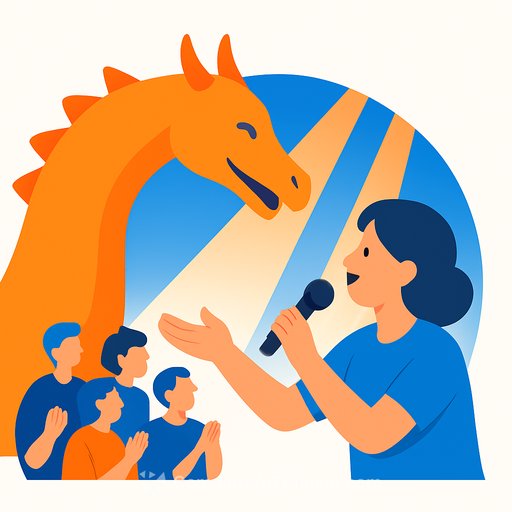
The 60-minute performance blends lecture, slide-shows, and fever dream. Kelly's work is pulled into an AI and altered in ways he never approves. The result feels intimate, unsettling, and very human.
Every performance includes an Auslan interpreter. Every seat has pencil and paper so the audience can draw their own dragons and donate them after. It's authorship as a shared act-without outsourcing the spark.
After a showing at West Berlyn, Perth Festival commissioned the work. With a successful festival run behind them, Berlyn and Kelly are aiming to tour, much like Kelly's first solo show, Arco.
Why this matters for creatives
- Draw your line: Decide where AI genuinely supports your process and where it dilutes your voice. Write that boundary down and share it with collaborators.
- Protect consent and credit: If your work is scraped or remixed without permission, say so. Add clear license terms and clauses in your contracts and presenter agreements.
- Prioritize process over polish: Your lived experience is the asset. Keep rehearsal rooms human, messy, and responsive. The audience feels the difference.
- Test, then choose: Run small experiments. If a tool drags your attention or flattens the work, cut it. Tools don't get artistic veto power-your taste does.
- Design for inclusion: Involve neurodiverse artists early and pay them. Build access (e.g., Auslan, tactile prompts) into the concept, not as an add-on.
- Mind the footprint: If you use AI, estimate its energy and water costs and offset where possible. Low-tech, high-touch moments can be both ethical and electric.
A closing note from the room
Berlyn calls it like he sees it: standing on the beach, watching AI pull the water out to sea-thrilling and terrifying at once. Kelly counters with presence: "I'm anxious, but I can use anxiety as energy." He feeds off audiences. The show meets that energy head-on.
Further reading for creative teams
Thinking through tools, ethics, and workflows? Start here: AI for Creatives and AI for Writers.
Your membership also unlocks: