AI that turns messy dynamics into compact, workable equations
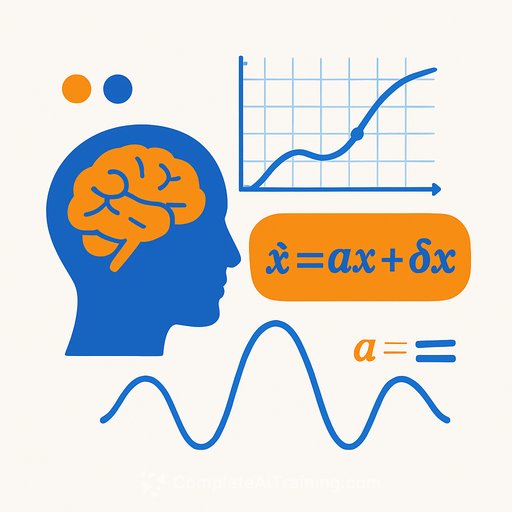
Duke University engineers introduced an AI framework that learns concise, interpretable equations from raw time-series data-think circuits, weather patterns, biological signals, and chaotic motion. Published in npj Complexity, the work aims beyond forecasting. The target is clean models scientists can analyze, trust, and use.
The effort is led by Boyuan Chen, director of the General Robotics Lab and Dickinson Family Assistant Professor of Mechanical Engineering and Materials Science, with lead author Sam Moore, a PhD candidate. Their take: we have the data; we've been missing the bridge from measurements to clear rules.
Why this matters for scientists
Dynamical systems theory gives us a language for change, but real systems are nonlinear, high-dimensional, and noisy. You can measure outcomes and still miss the governing structure. Past methods often balloon into huge latent spaces that predict yet remain hard to interpret and easy to overfit.
Science moves when we find compact reductions that hold the core truth. That's the practical bar this framework is trying to meet.
A 1931 idea, modernized
The method builds on the Koopman operator: under the right coordinates, a nonlinear system can look linear. Linear systems are easier to analyze-you get modal structure, stability, and global behavior. The catch has always been scale. Prior approaches often needed embeddings far larger than the original system, which diluted interpretability.
How the Duke framework works
The model learns a latent space (ψ) where the dynamics evolve linearly. It uses time-delay embedding to feed short histories of the system, then predicts ahead. A mutual-information criterion helps pick the time-delay length, which strongly affects accuracy.
Training emphasizes long-horizon performance with a discounted multi-step loss. The discount ramps over time, helping the model generalize beyond the training window. The team then scans latent dimensions and selects the smallest that preserves performance. They also penalize unstable growth by discouraging eigenvalues with positive real parts, keeping learned dynamics physically sane.
Benchmarks: smaller models, long-horizon stability
Nine datasets spanned simulated and experimental systems: single and double pendulums, Van der Pol, Duffing (double-well), Hodgkin-Huxley, Lorenz-96, nested limit cycles, magnetic interactions, and an experimental magnetic pendulum. The progression moves from textbook to unruly.
Across cases, the framework produced reduced linear embeddings more than 10x smaller than many machine-learning baselines, while holding long-horizon accuracy. Examples: a 3D latent for Van der Pol, 6D for Duffing, and 14D for a 40-state limit-cycle Lorenz-96-all with strong predictive performance.
Interpretability: modes, attractors, and stability tools
Because the learned dynamics are linear in ψ, you can run spectral analysis-extract eigenvalues and eigenfunctions that map to modes, frequencies, and decay rates. The team also builds practical stability certificates using decaying modes as neural Lyapunov functions, offering a path to global stability assessments that are often out of reach for nonlinear models.
As Moore put it, finding stable structures gives you landmarks. Once those are clear, the rest of the behavior becomes easier to reason about.
What you can do with it
- Accelerate hypothesis formation: move from raw measurements to candidate governing rules you can test.
- Design smarter experiments: identify variables and time horizons that carry the most information.
- Early warning and control: detect drift toward instability in grids, aircraft dynamics, or biological rhythms; evaluate interventions before deployment.
- Model auditing: use modal structure and Lyapunov functions to stress-test learned dynamics for realism, not just fit.
Practical notes
- Data quality still matters. Coverage across regimes improves spectral estimates and stability checks.
- Time-delay selection is pivotal; the mutual-information heuristic helps, but validate against out-of-sample behavior.
- Interpretability depends on compactness. Prefer the smallest latent that preserves long-horizon accuracy.
Learn more
Paper and context:
Skill-building for AI-in-science workflows
If you're formalizing skills around modeling, time-series, or control, explore role-focused training: AI courses by job.
Your membership also unlocks: