'I don't': Dutch court says AI-written wedding vows void the marriage
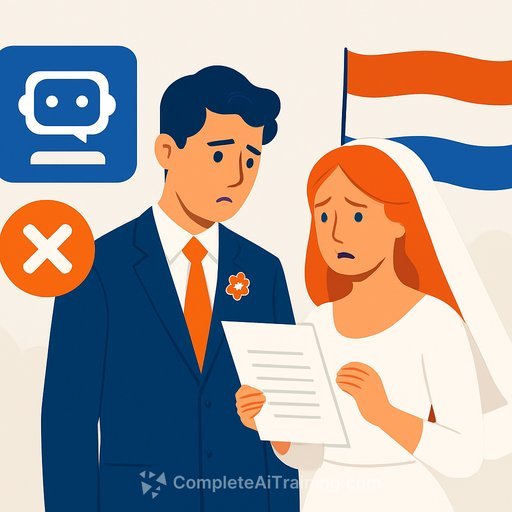
A Dutch court invalidated a couple's marriage after finding their wedding vows were drafted with help from artificial intelligence. The ceremony was held in April 2025 in Zwolle, but the court ruled the union did not meet legal requirements.
For legal professionals, this is a clear signal: declarations of will in civil acts must be unmistakably human. If machine-generated text blurs authorship or intent, the act is at risk.
The legal crux
Marriages hinge on capacity, free consent, and strict formalities before a registrar. If vows are produced by a tool rather than expressed and adopted by the parties themselves, a court can view consent as defective or unproven.
The problem isn't "using AI" per se. It's proof of agency: did each person personally make the declaration required by law, in the required form, at the required moment?
Risk areas to watch
- Authenticity of consent: Are the words the individual's own, understood and voluntarily adopted?
- Agency and proxies: No tool or third party should substitute the person's declaration.
- Form compliance: Statutory wording/format before the registrar must be clear and contemporaneous.
- Evidence: If the text's origin is unclear, the record won't carry the day in court.
- Privacy: Prompts and personal data fed into public models may raise GDPR issues.
Practical steps for registrars, notaries, and counsel
- Require explicit, spoken acceptance: the parties must state the legally required declaration in their own words.
- If AI was used in drafting, have each party confirm they reviewed, understood, and adopted the final text before the ceremony.
- Use standardized language for the core legal consent; keep creative vows separate and clearly optional.
- Document authorship: who drafted, what tool was used, final text approved, and when.
- Maintain a contemporaneous record (audio/video or detailed minutes) that captures the actual declaration.
- Add an "AI-use" clause to checklists and ceremony protocols; train staff to pause proceedings if authenticity is in doubt.
- Advise clients in writing that automated or delegated declarations can jeopardize validity.
Policy and compliance angles
Expect more disputes where generative tools touch civil acts. Map where AI is permitted (drafting aids) versus prohibited (substituting the act of consent).
Align practices with formal requirements in family law and with AI governance obligations. For reference, see the Dutch Civil Code, Book 1, on marriage formalities and the EU's AI Act framework on transparency and risk controls.
What to document in your file
- Final wording of the legal declaration and clear separation from any creative vows.
- Authorship trail: tool used (if any), prompts, drafts, and the moment each party approved the final text.
- Registrar's note that the declaration was made personally and voluntarily.
- Proof of understanding for non-native speakers (translation, interpreter confirmation).
Bottom line
Consent is personal. Let AI help with ideas if clients insist, but the legal declaration must be theirs-spoken, clear, and on record. Until jurisprudence settles, take the conservative path and document everything.
If your firm is building internal training on safe AI use in client-facing processes, see practical course paths by role: AI for Legal, AI Learning Path for Regulatory Affairs Specialists, and AI Learning Path for CIOs.
Your membership also unlocks: