Florida's E-Verify expansion and AI oversight: What insurance professionals need to know now
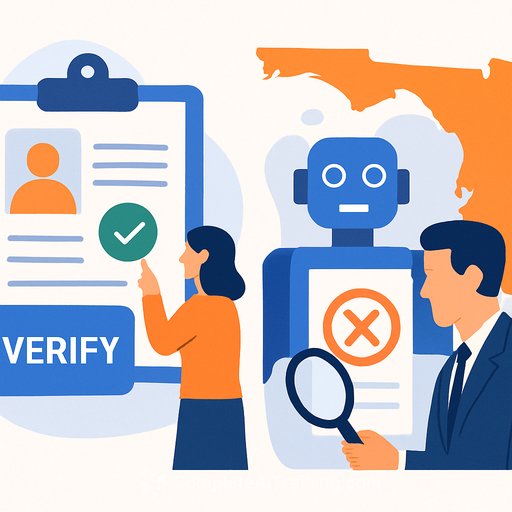
Two moves in Tallahassee could affect how insurance businesses hire and how they handle claims. One bill would expand E-Verify to all private employers. Another push would put guardrails on artificial intelligence in claims decisions.
E-Verify expansion: the bill and its reach
House Bill 197 advanced in the House and is now before the Commerce Committee. The measure would require every private employer in Florida to use E-Verify to confirm work authorization before hiring.
Current law applies only to private employers with 25+ employees. Florida has nearly half a million businesses with fewer than 20 employees, which means a large wave of small insureds could be pulled into compliance for the first time.
- Penalties: Three violations in 24 months could trigger a $1,000-per-day fine until the company complies.
- Supporters say: The system is efficient with a low error rate and strengthens workforce integrity.
- Opponents argue: It adds burden for small businesses already struggling to hire.
Implications for carriers, MGAs, agencies, and brokers
- Workers' comp and EPL risk: Non-compliance can signal operational risk and cash flow strain. Underwriters should add E-Verify usage and controls to pre-bind questionnaires.
- Small commercial: Expect questions from clients unfamiliar with E-Verify setup and recordkeeping. Provide simple guidance on onboarding workflows and document retention.
- Policy language: Review warranties, conditions, and compliance-related exclusions that could be triggered by fines or illegal employment practices.
- Your own HR: If you employ in Florida, audit hiring steps, vendor background-check flows, and E-Verify account administration.
AI in insurance: oversight, disclosures, and "human in the loop"
Florida's Insurance Commissioner told lawmakers he wants oversight of how carriers use AI, with emphasis on disclosure, auditability, and a clear human in the loop who understands and is accountable for system outputs. Lawmakers have also filed a bill stating no claim can be denied by algorithms, AI, or machine learning systems alone.
The House is hosting "Artificial Intelligence Week" (Dec. 8-12) to examine AI across sectors. There's debate over whether rules should be national or state-based. Some argue national standards would prevent a patchwork of rules, while the Governor supports states taking the lead.
For official updates and bulletins, monitor the Florida Office of Insurance Regulation.
Operational impact on claims, SIU, and underwriting
- Human decision requirement: If the bill passes, any denial must be made by a qualified human. AI scores, summaries, or recommendations can inform, but not decide.
- Audit trail: Document who reviewed, what data they considered, why the decision was made, and how AI outputs were weighed.
- Model governance: Maintain data lineage, version control, validation results, bias testing, and monitoring. Schedule periodic audits.
- Vendor oversight: Amend contracts to require explainability, error reporting, bias mitigation, and right-to-audit for third-party tools.
- Adverse action and communications: Standardize denial letters to reflect human review and cite evidence, not just an algorithmic score.
- Change management: Train adjusters on where AI is used, known limitations, and how to override or escalate.
Compliance checklist you can start now
- Map AI usage: Inventory every model and tool touching underwriting, pricing, claims triage, SIU, and customer communications.
- Identify decision points: Mark where a human must own the final call. Update SOPs to require sign-off and rationale.
- Revise letters and scripts: Ensure denials and coverage decisions reflect human judgment and cite verifiable facts.
- Stand up an AI review board: Legal, compliance, actuarial/data science, claims, and security should meet on a set cadence.
- Bias and performance testing: Define metrics, run pre-deployment and ongoing tests, and document remediation steps.
- E-Verify readiness (if you employ in FL): Register, test your onboarding workflow, and train HR on identity mismatch resolution.
For brokers and client-facing teams
- Brief your small business clients: Share a one-pager on E-Verify duties, fines, and onboarding steps. Point them to the official E-Verify portal.
- Underwriting narratives: Ask prospects about hiring controls, I-9 process, and E-Verify adoption. Note any gaps.
- Risk advisory: Recommend documentation habits that also help during claims-time-stamped records, system logs, and training attestations.
Open questions to watch
- Will the E-Verify bill include grace periods or safe harbors for small employers?
- How will Florida define "use of AI" for claims decisions, and what counts as sufficient human review?
- If multiple states enact different AI rules, how will multi-state carriers normalize workflows?
If your team needs practical training on AI oversight, model risk, or prompt-safe workflows for claims and underwriting, explore focused programs here: AI courses by job.
Your membership also unlocks: