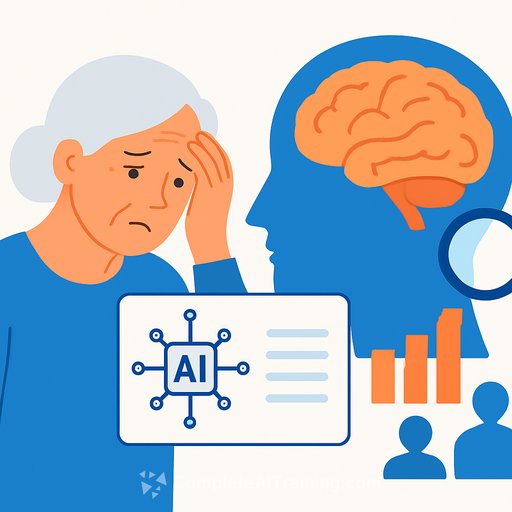
Where AI Is Already Delivering in Alzheimer's Disease
AI is starting to pull early Alzheimer's signals out of noise. The catch: if the data isn't representative, the benefits won't reach the people who need them most. The field is now crossing from demos to deployment, with concrete progress in early diagnostics, multi-omics integration, and trial optimization.
Early diagnostics are breaking through
Models trained on imaging, fluid biomarkers, and speech are picking up subtle changes years before symptoms. In recent work highlighted by leaders in the field, AI-enabled speech analysis has flagged pre-symptomatic cognitive decline with surprising sensitivity, suggesting a path to low-cost, remote screening.
Researchers are also rethinking the A/T/N framework. Beyond A (amyloid) and T (tau), the "N" for neurodegeneration is expanding to include digital and AI-derived biomarkers-signals from speech, behavior, wearables, and other passive measures. That shift could turn primary care visits and routine check-ins into meaningful windows for earlier, more accurate detection.
Proteomics is the new engine for discovery
Large-scale proteomics is especially valuable for AI because it reflects real-time biology and points directly to druggable targets. When you combine proteomics with genomics, imaging, and clinical data, you get the kind of multi-modal signal that foundational disease models need.
Consortia-backed resources, such as the Global Neurodegeneration Proteomics Consortium's harmonized datasets, are critical. Large, clean, and consistently labeled data-shared through secure platforms like the AD Workbench-are accelerating biomarker discovery and target identification at a scale that individual labs can't match.
What changed in the last 12-24 months
Model capability jumped. Teams moved beyond basic generative tools to agentic systems that can reason across tasks, plan, and iterate with minimal supervision. That unlocks literature synthesis, hypothesis generation, and multi-omic analysis at speeds humans can't match.
At the same time, the data foundation got stronger. Harmonized datasets with breadth and depth are now available, enabling training runs that produce clinically relevant insights. Initiatives are even stimulating new ideas: a recent prize from the Alzheimer's Disease Data Initiative sought the best applications of agentic AI, with finalists pitching at a major neurology meeting in Copenhagen.
The equity gap: where AI can fail patients
The biggest risk is one we can't ignore: biased models that miss or misclassify disease in underrepresented groups. Skewed imaging datasets can drive underdiagnosis. Biomarker-based models can misestimate risk when genetic factors (like APOE4) vary across populations. Trials still over-represent highly educated, research-engaged participants while minorities-often at higher risk-remain under-enrolled.
Some groups are addressing the gap head-on by expanding datasets with cohorts from Latin America, Africa, and Asia. That's the direction the field needs-paired with rigorous validation across settings and clear reporting of model performance by subgroup.
- Source diverse cohorts early; don't "fix" bias post hoc
- Predefine fairness and calibration metrics; report by subgroup
- Validate across sites, scanners, and languages; avoid brittle pipelines
- Plan for access: cost, workflow fit in primary care, and minimal compute
- Use transparent documentation (data sheets, model cards) and governance
What success should look like for patients and families
- Earlier, more accurate diagnosis that fits into routine primary care, with less invasive tests and lower cost
- Faster development of effective therapies via AI-prioritized targets and smarter, potentially shorter trial designs
- Personalized strategies that match the right intervention to the right person at the right time
If AI disappeared tomorrow
We'd lose scale, speed, and the ability to synthesize multimodal evidence. The volume of literature, imaging, and omics data in dementia research already exceeds what any team can track. Without AI to surface patterns, many insights would stay buried.
Practical next steps for research teams
- Prioritize multi-modal data assembly (proteomics + genomics + imaging + clinical)
- Invest in harmonization and QA before model training
- Co-develop with clinicians and community partners to ensure real-world fit
- Budget for external validation and subgroup performance assessment
- Plan the pathway to deployment: regulatory, workflow integration, and monitoring
About Dr. Niranjan Bose
Niranjan Bose, PhD, is the interim executive director of the Alzheimer's Disease Data Initiative and managing director (Health & Life Sciences Strategy) at Gates Ventures, where he serves as science advisor to Bill Gates. Previously, he served at the Bill & Melinda Gates Foundation, including roles in the Global Health Program and Enterics and Diarrheal Diseases strategy, and earlier as a senior consultant in life sciences strategy. He holds a PhD in biochemistry from Dartmouth College and degrees in biological and pharmaceutical sciences from BITS Pilani.
Resources
Skill-building for applied AI workflows
If your team is building capability in agentic workflows, multimodal modeling, or AI validation, you may find these curated learning paths useful: AI Research Courses, AI Design Courses, and the AI Learning Path for Training & Development Managers.
Your membership also unlocks: