AI and Google Are No Substitute for a Doctor's Visit
We carry answers in our pockets. That doesn't make them correct. Speedy search results and slick AI outputs are still guesses without a clinical context.
Information is not health care. A clinician who knows a patient's history, baseline, and risk factors can see what algorithms can't: subtle change over time. That longitudinal view-revealed by careful Data Analysis of labs, imaging, and trends-is where lives are saved.
Why regular visits change outcomes
Early diagnosis is the leverage point. Following patients over months and years reveals small deviations in labs, symptoms, and imaging before they become a crisis. That window is where treatment is simpler and outcomes are better.
In oncology, timing is everything. Localized breast cancer has about a 99% five-year survival rate, and prostate cancer detected early approaches the same. That curve bends the other way as stage advances. Sources: ACS breast cancer survival, ACS prostate cancer survival.
Preventive medicine is the simplest, highest-yield play in care delivery. Annual check-ups, routine bloodwork, and age-appropriate screenings-colonoscopy, mammography, Pap tests, and prostate evaluations-catch problems before they become problems.
Where AI helps-and where it doesn't
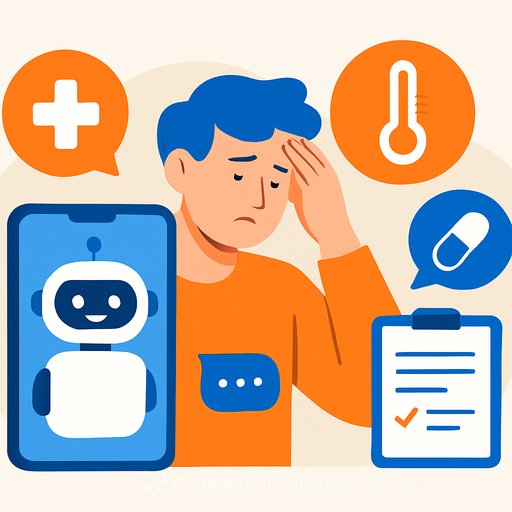
Search engines and AI tools work from generalized data and probabilities. They don't know the person in front of you. A fatigue query might surface stress and dehydration. The patient might have hypothyroidism, anemia, or malignancy-diagnoses that require a physical exam, targeted labs, and judgment.
These tools also amplify worst-case scenarios, feeding anxiety and self-treatment. They don't palpate an abdomen, hear a murmur, or decide which test to order next. Clinical decisions require training, context, and accountability.
Practical guardrails for clinicians using AI
- Keep AI in the loop-not in charge. Use it for education, drafts, and pattern prompts; apply Prompt Engineering guardrails, but never treat it as the final word on diagnosis or management.
- Anchor every suggestion to patient-specific data: history, exam, vitals, labs, and imaging before acting.
- Set expectations with patients: AI is a tool, not a clinician. Invite questions, but route decisions through evidence and your assessment.
- Build reliable recall systems for check-ups and screenings; pair with risk stratification rather than letting self-diagnosis drive care.
- Close the loop. Schedule follow-ups to verify changes, adjust plans, and prevent drift.
What to do next
Audit your panel for gaps: overdue annual visits, missing labs, and lapsed screenings. Standardize outreach. Make "next appointment booked" a default, not an exception.
Encourage patients to bring their search results-and then translate them into action. Let technology support your workflow, but keep clinical judgment at the center.
If you want structured, practical upskilling on responsible AI use in clinical workflows, explore curated options by role: Complete AI Training: Courses by Job.
Bottom line: Technology can support care, but it should never replace it. The safest path to long-term health is proactive, relationship-based medicine anchored by regular visits and evidence-based screening.
Your membership also unlocks: