AI in Education: We Need Transformation, Not Just Improvement
We've reached a point where adding AI to yesterday's system won't cut it. Technology has already changed how people think, learn, and work. Education has to catch up-at the system level-not with small tweaks, but with a full reframe of purpose, practice, and proof of learning.
Highlights
- We're educating for a world that no longer exists. AI is being layered onto pre-digital structures while tech reshapes cognition, attention, and mental health.
- Incremental improvement is too small for the problem. Optimization won't fix the learning crisis, inequity, or relevance gap. Transformation will.
- Future value sits at the intersection of strong general skills and human judgment. That's where complex, "messy" work lives-and where AI doesn't replace people.
The Reality We're Already Living
Time use has flipped. A century ago, life centered on family and community. Today, most waking hours run through screens. Early screen exposure is tied to accelerated brain network maturation in infants, which can limit flexibility and resilience later on. For adolescents, social media, cyberbullying, and isolation add pressure during a critical window of prefrontal development.
There's another risk: cognitive offloading. A 2025 MIT study found that heavy reliance on AI for thinking tasks led to weaker neural engagement, poorer recall, and a thinner sense of ownership over writing. AI can help, but overuse builds cognitive debt students pay for later.
If you work in education, this isn't theoretical. You see the attention cliffs, the copy-paste essays, and the motivation gaps. The environment has shifted. Our systems haven't.
Improvement vs. Transformation
Improvement makes current practices a bit faster or cheaper. It's local, hard to scale, and leaves core assumptions untouched. Transformation rewires how the whole system works-curriculum, instruction, assessment, teacher development, and governance-so learning outcomes match the world students are entering.
Put simply: improvement optimizes parts. Transformation aligns the whole.
Foundations First, Then Smart Specialization
Human capital isn't flat. Research on "hierarchical nestedness" shows two kinds of specialized skills: un-nested skills (narrow, learnable without strong foundations, low returns) and nested skills (built on broad capabilities, high returns, enable upward mobility). Workers who win don't stack random certificates; they deepen general skills and add targeted specializations on top.
So what are the foundations? Reading and writing at depth. Numeracy and data sense. Reasoning, problem solving, and metacognition. Communication, collaboration, and ethics. Digital fluency with critical thinking. Get these right, then build nested specializations that compound.
Single-Task vs. Messy Jobs
Well-defined, single-task roles are easy to automate. That window is closing fast. Messy jobs-those combining judgment, local knowledge, relationships, and real-world execution-are far more resilient. They're also where AI becomes leverage, not a replacement.
Advice for students (and for how we design learning): choose the messy work. That's where human value compounds.
What This Means for Schools and Systems
If AI is to augment people, not replace them, schools must do two things at once: protect and grow general competencies, and build nested specializations tied to real problems. Knowledge is cheap. Judgment, synthesis, coordination, and execution are not.
What To Do Next (Practical Moves)
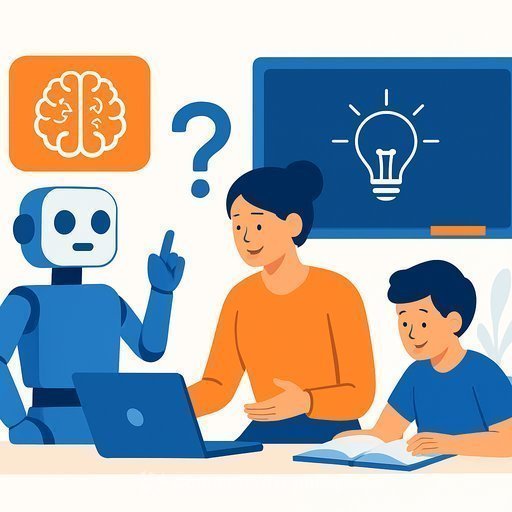
- Curriculum: Anchor units in real problems with constraints, stakeholders, and ambiguity. Require students to plan, decide, and execute-not just search and summarize. Integrate AI as a partner: research assistant, critique engine, simulator-not an answer machine.
- Assessment: Shift from product-only grading to process evidence: portfolios, oral defenses, live performances, and team deliverables with clear role accountability. Use AI-aware rubrics (idea quality, judgment, source use, originality, reflection). Weight metacognition heavily.
- Classroom Practice: Use an "AI-augmented work protocol":
- Fetch (use AI to explore, gather options)
- Think (offline planning, retrieval, outline)
- Produce (human-first draft, then AI critique)
- Verify (source checks, fact flags, oral explanation)
- Teacher Development: Create rapid cycles of learning (micro-credentials, peer labs, co-planning studios). Provide model prompts, exemplars, and do-tanks where teachers test AI-supported lessons with real students. For practical design methods and curricula, see AI Design Courses.
- Governance & Equity: Set age-appropriate device and AI guardrails, privacy standards, and procurement norms. Fund access for underserved schools. Track outcomes beyond test scores-portfolios, capstones, and workplace-aligned performance tasks.
- Early Years: Tighten screen policies. Prioritize language, play, physical activity, and human interaction. Save AI for teacher workflow, not child-facing use.
Guardrails That Protect Thinking
- AI last, not first: Start with a plan or outline before prompting. This preserves original thought.
- Transparency by default: Students label where AI contributed and how they verified outputs.
- Oral defense: If you can't explain it live, you don't own it. Short viva-style checks deter over-reliance.
- Retrieval over rereading: Low-stakes quizzes and reflections rebuild memory traces AI can't build for students.
Evidence To Watch
Emerging research links infant screen exposure to altered brain development and adolescent social media use to mental health risks. For a useful overview, see the American Academy of Pediatrics' guidance on media use for young children here. For teacher perspectives and practice data, explore OECD's TALIS resources here. For training and deeper methods in evaluating these findings, consider AI Research Courses, and for courses focused on social-media impacts and interventions see AI Social Media Courses.
For System Leaders
- Publish an AI use framework that's simple, specific, and revisited quarterly.
- Invest in teacher time: release days for redesign, not extra mandates.
- Adopt performance-based graduation artifacts (capstones, internships, entrepreneurship, community projects).
- Measure what matters: judgment quality, transfer across domains, and execution under constraints.
This isn't about making school slightly better. It's about building an education model that prepares people for complex, human-centered work where AI is a tool, not a crutch. The question isn't "Should we use AI?" It's "Will our system produce thinkers who can connect, adapt, and execute in messy, real contexts?"
If you want a deeper view of how education systems are responding, explore the latest regional work highlighting 193 AI initiatives across teaching, inclusion, and school management, plus new insights from TALIS 2024. The signal is clear: where alignment exists, gains follow.
Keep Learning
Looking to build practical AI skill paths for your role or team? Browse role-based course maps and certifications at Complete AI Training.
Your membership also unlocks: