
AI news ·
EFF argues Trump administration's sanctions on Anthropic are unconstitutional retaliation
A court blocked Trump sanctions against Anthropic that risked hundreds of millions of dollars. The move targeted the AI firm for refusing to build autonomous weapons.
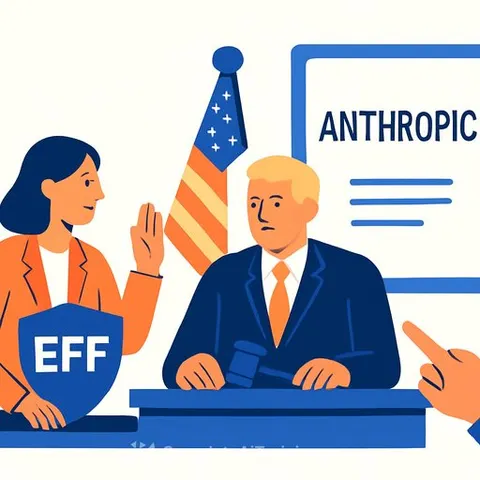
A federal court has temporarily blocked Trump administration sanctions that would have banned government agencies from doing business with AI developer Anthropic, after the company refused to allow its models to be used for autonomous weapons and domestic surveillance. EFF and other civil liberties organizations filed an amicus brief arguing the sanctions violate the First Amendment because they were retaliation, not a genuine security measure.
The administration designated Anthropic a "supply chain risk" - a move that would have cost the company hundreds of millions of dollars - and later imposed export controls that forced Anthropic to shutter two of its most advanced models. The sanctions stood in contrast to the administration's otherwise hands-off AI policy, which has rolled back even basic cybersecurity regulations for frontier models.
The sanctions followed a refusal to cooperate
For years, federal agencies used Anthropic's models in classified systems. The relationship soured after Anthropic resisted government demands to apply its technology to fully autonomous lethal weapons and domestic spying programs. The administration responded by targeting the company with heavy-handed rules that applied to no other AI lab.
The preliminary injunction, issued earlier this year, halted sanctions that EFF's brief described as "clear retaliation for the company's public refusal to allow the Pentagon to use its models to develop fully autonomous weapons and spy on Americans." The brief argues that punishing a company for its speech and refusal to participate in constitutionally fraught activities violates core First Amendment protections. Even with the injunction in place, the episode sent an unmistakable signal to industry: comply with government wishes or risk economic ruin.
Export controls became the next front
The administration then used an executive order to impose export controls banning any foreign national from accessing Anthropic's Mythos and Fable models. To comply, Anthropic turned the models off entirely. Officials cited fears that Mythos-class models could locate and exploit software vulnerabilities - a capability already present in other large language models that face no such restrictions.
Other LLMs with similar offensive cybersecurity potential are subject only to a voluntary framework where companies can submit models for testing 30 days before release. As leading cybersecurity experts argued in an open letter, blocking access to these tools prevents security teams from finding and patching flaws before adversaries can exploit them with nearly equivalent AI. The inconsistency undermines any claim that the controls are based on objective risk assessment.
Code remains speech, decades later
EFF's legal challenge draws a direct line to the 1990s fights over encryption software, when courts established that code is protected speech under the First Amendment. Software is more than functional; it carries ideas, knowledge, and technical expression. Restrictions on who can access AI models raise the same constitutional questions, especially when imposed without clear standards.
"Depriving the public of the best AI threatens our rights without making us any safer," the brief states. Export controls are particularly open to abuse because they can be applied unilaterally and selectively, as happened here. Whether the motive was punishment or misguided security policy, the public loses when important tools are walled off from researchers and defenders.
Why this matters for government professionals
For policymakers and public servants, the case underscores a fundamental tension in AI governance: regulation must be rational and evenhanded to withstand legal scrutiny and earn public trust. When officials impose severe, selective restrictions on one company while giving others a voluntary pass, they invite constitutional challenges and practical failure. Understanding the legal boundaries of technology policy is now essential for anyone in government who touches AI, procurement, or national security. The AI Learning Path for Policy Makers can help build that competency. For those working directly with public sector AI deployments, training resources on AI for Government offer guidance on navigating these evolving rules without overstepping legal limits.