What AI Cannot Do: The Case for Human-Centered Leadership
About 100 hospitality industry professionals and students gathered at EHL Hospitality Business School in April for Women in Leadership Day 2026, where a central question emerged: as AI takes on more organizational work, what must leadership protect as fundamentally human?
The answer, participants found, was not about tools or systems. It was about judgment and presence-the things no algorithm has yet learned to replicate.
The Infinite Workday and the Erosion of Judgment
AI is already embedded in how organizations operate. It drafts reports, processes data, suggests decisions and monitors performance. It does not stop or get tired. This acceleration is what makes the leadership conversation urgent.
Students at the event identified a particular risk: what they called the infinite workday. This is not about longer hours. It is about how organizations measure value when availability becomes a performance signal and switching between tasks every three minutes is normalized.
When boundaries between work and everything else disappear, what suffers first is not productivity. It is judgment. And judgment is what leaders exist to exercise.
When Systems Replace Decision-Making
There is a narrower concern beneath this. Practice builds capability. When tools generate solutions independently, the human capacity behind those solutions can atrophy.
AI offers speed and convenience. But convenience applied without awareness erodes the humanity on which leadership depends. Leaders risk gradually stopping leading and starting deferring to systems instead, trusting outputs without questioning them and losing the habit of genuine human judgment.
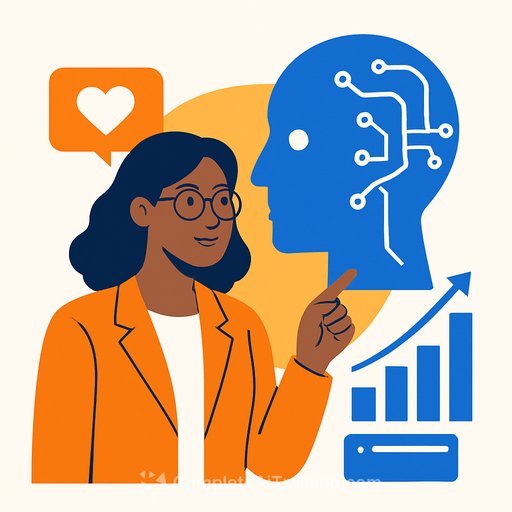
The gap between what AI can simulate and what a human leader actually delivers is narrowing. AI can express empathy. It can draft persuasive communication. In some contexts, research shows it outperforms senior executives on specific tasks.
What it cannot do is initiate a genuine relationship. It cannot call to check in. It cannot sense when the same words will land differently with different people. It cannot read the political and cultural texture of a room and decide, in that moment, what the right thing to say is.
These are the diagnostic tools of real leadership: understanding not just what is happening in an organization, but why and what it means for the people inside it.
Culture Amplified, Not Created
Organizations are not yet taking seriously enough how AI affects workplace culture. AI does not create culture. It amplifies whatever culture already exists.
In a people-centered organization, AI can accelerate trust, inclusion and growth. In a broken one, it becomes a mechanism for control: measuring, monitoring and reducing people to data points. The technology is a mirror. What it reflects depends entirely on the humans who shape it.
The Case for Slowing Down
Slowing down is not a retreat from the pace of change. It is a precondition for leading through it. You cannot guide people through uncertainty if you are not anchored yourself. You cannot inspire trust while running on cortisol.
You cannot build the kind of culture that AI can amplify for good if you have not first done the patient, unglamorous work of actually building it.
The conversations at Women in Leadership Day were honest. The energy was real. This is not something a system generates. It is something humans choose to create.
For those working in hospitality and events, where relationships and judgment under pressure are core to the role, understanding these boundaries matters. Learn more about AI for Hospitality & Events and how to maintain human-centered leadership as your organization adopts new tools.
Your membership also unlocks: