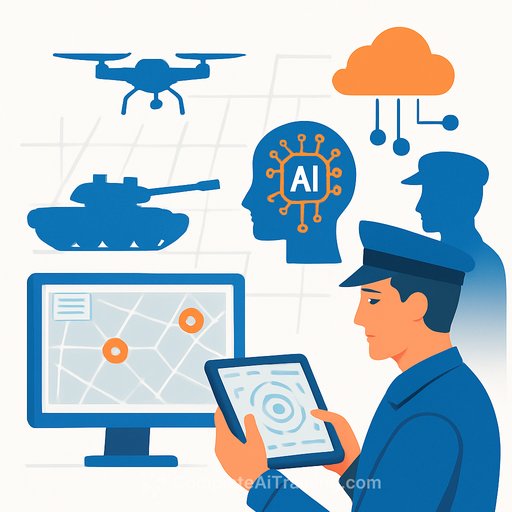
Elbit Systems wins $100M to expand AI-enabled C4I and sensor fusion for the IDF
Elbit Systems secured roughly $100 million in new contracts with Israel's Defense Ministry to advance the Israel Defense Forces' digitization stack. The work centers on two programs: a fifth-generation Digital Ground Army array (Tzayad) and the Multi-Sensor Border Defense System (MARS).
The priorities are explicit: increase force survivability, enhance lethality, and keep the human in control. "The most important objective of the system is to increase force survivability while also enhancing lethality," said Doron Daniel, Senior VP of Elbit's Network and Warframe Systems. "AI will not replace the human in the loop... responsibility for the decision always remains with the commander."
What's shipping: Tzayad and MARS
Tzayad (Digital Ground Army) adds advanced command-and-control across headquarters and maneuver units with full multi-domain connectivity across air, sea, and land. A core feature is AI-assisted decision support that surfaces insights from large volumes of battlefield data so commanders can decide faster with more context.
MARS (Multi-Sensor Border Defense System) brings rapid integration of heterogeneous sensors and effectors, AI-based analytics, broad multi-mission management, and multi-service connectivity. Think high-throughput data fusion at the edge, with tasking and response loops compressed to seconds.
"The new systems will constitute another significant leap in the IDF's capabilities in the fields of C4I and digital, and represent a direct implementation of the lessons learned from combat over the past two years," said Colonel S., head of the Aderet Department in the Ground Technological Division.
Architecture notes for engineers
- Open architecture: The stack is built to integrate "best-in-class technologies" that meet IDF requirements. Expect modular services, well-defined interfaces, and strict accreditation. This favors a plug-and-play model across radios, sensors, effectors, and UIs.
- Multi-domain connectivity: Cross-service data and tasking require common data models, identity, and policy layers. Low-latency message buses and resilient mesh networking are table stakes in denied or degraded comms.
- Data fusion at scale: Sensor heterogeneity (EO/IR, radar, SIGINT, UAS feeds, ground sensors) means timestamp alignment, georegistration, and confidence scoring baked into the pipeline. Provenance and audit trails matter for post-mission review.
- AI as decision support: Models prioritize targets, flag anomalies, and summarize the tactical picture. Human-in-the-loop is non-negotiable; UI/UX must enable fast overrides, explainability cues, and ranked recommendations rather than hard automation.
- Edge-first deployment: Compute sits close to sensors. Models need quantization, pruning, and update channels that tolerate low bandwidth. Caching, offline operation, and graceful degradation keep units operational.
- MLOps and model governance: Version control, canary rollouts, telemetry, drift detection, and red-teaming are required to keep models trustworthy in changing conditions.
- Security: Zero-trust principles across the transport and app layers, hardware roots of trust on edge devices, and continuous attestation limit blast radius if nodes are compromised.
- Operator workflows: Every node should plan and execute missions for itself and subordinates using the same digital toolset. Expect shared situational awareness, blue/red force tracking, and streamlined kill-chain orchestration.
Context: two decades of iteration
According to Elbit, the current digitization array builds on 20+ years of the Digital Army Program. What started as location and blue force tracking has matured into a full mission planning and execution environment at every echelon.
"Today, each node and each force has the capability to plan its (and subordinates') next mission and execute it using the full range of digital tools available to it within its specific tactical or deployed operational environment," Daniel said.
Why it matters for IT and dev teams
- Clear product goal: compress the observe-orient-decide-act loop without removing human judgment.
- Technical path: modular services, standard data contracts, and strict CI/CD for models and mission apps.
- Operational proof: capabilities reflect lessons learned from recent combat, meaning requirements are validated in the field, not just on a whiteboard.
"These new programs will enable us to develop unique, world-leading capabilities in the fields of digital warfare and artificial intelligence," said Haim Delmar, General Manager of Elbit Systems C4I & Cyber. The intent is straightforward: higher operational effectiveness and a durable tech advantage.
For further reading
- DoD's AI ethical principles (human-in-the-loop focus)
- AI courses by job role (practical upskilling for engineers)
- AI Learning Path for Network Engineers
Your membership also unlocks: