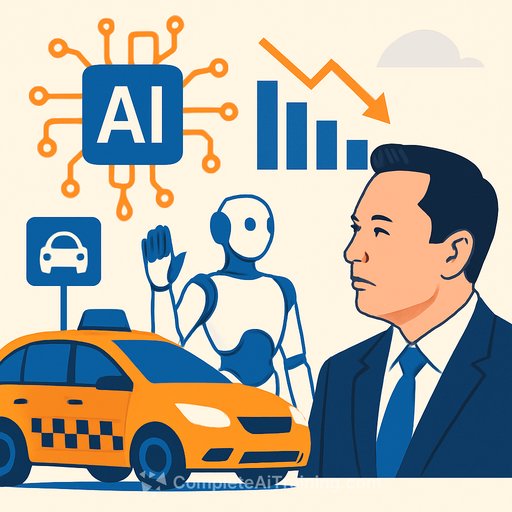
WEF: Elon Musk on Robotaxi, AI and Robotics - Strategic Signals for Executives
Elon Musk used the Davos stage to lay out a blunt thesis: autonomy, abundant energy, and humanoid robotics will reset cost structures and labor models across industries. His message to operators and investors was clear - align capital and policy capability now, or watch from the sidelines later.
Autonomous vehicles: tech-ready, policy-constrained
Musk said autonomous transport is "essentially a solved problem," and noted Tesla has deployed robotaxis in several U.S. cities, aiming for "very widespread" rollout by year-end. Yet the Cybercab is under federal scrutiny after videos of traffic violations in Austin surfaced, and the broader program faces an active investigative backdrop.
Internationally, Tesla is seeking approval for supervised Full Self-Driving in Europe (from February 2025) and pursuing similar timelines in China. The real bottleneck isn't code; it's approvals, liability frameworks, data rules, and local politics. Expect uneven availability across regions and a stop-start commercialization path.
NHTSA and equivalent regulators abroad will define the pace more than engineering milestones. Plan for regulatory drift and compliance costs rather than a clean, national switch-on.
Energy strategy: AI demand vs. policy friction
Musk argued the U.S. could be energy self-sufficient via solar - citing southwest land availability - but called current solar tariffs a major blocker that inflates deployment costs. That stance runs counter to President Donald Trump's focus on oil and gas and the freeze on solar project approvals.
He tied this directly to AI: data centers will need much more power, and access to affordable, buildable supply is "critical." For operators scaling Gen AI, this moves energy procurement from a facilities line item to a board priority. Tariff policy, interconnection timelines, and storage strategies now factor into competitive advantage.
Humanoid robotics: from factory tasks to households
Musk projected "more robots than people" in the future, framing it as a path to abundance and a pressure valve for aging demographics. Tesla's Optimus is handling simple factory work today; he expects more complex tasks by year-end and consumer sales "by the end of next year," with "very high reliability" by late 2026.
The near-term use cases are practical: manufacturing cells, logistics, elder care, and in-home support. He also flagged safety risks plainly: "We need to be very careful with robotics. We don't want to find ourselves in a James Cameron movie." Ongoing scrutiny of AI systems - including reports of "sexually explicit content" from xAI's Grok - underscores how safety and governance could slow rollout even if demand is strong.
AI timelines and macro impact
Musk predicted AI that outperforms individual humans "by the end of this year," with collective human-level capability around 2030-2031. If that holds, expect a sharp reset in labor allocation, productivity baselines, and the structure of cost advantage across sectors. Capital that can reconfigure workflows fastest will win.
Executive playbook: actions to take now
- Autonomy readiness: build a regulatory map by state and country; stage pilots with clear KPIs; secure insurance and incident response; budget for ongoing compliance and data retention.
- Energy resilience for AI: quantify expected compute load; line up power procurement options (PPAs, on-site solar + storage where feasible); model tariff sensitivity; prioritize locations with favorable interconnection paths.
- Robotics pilots: target high-injury, high-turnover tasks first; define safety gates and human oversight; align with labor councils early; set procurement and maintenance standards.
- Capital and risk: run scenarios for 12-36 month adoption curves; tie capex to milestone triggers; diversify vendor exposure across autonomy, robotics, and AI stacks.
- Governance: implement AI/robotics safety reviews, content controls, and red-team testing; publish clear usage policies for employees and vendors.
- Workforce plan: create reskilling paths for operators and technicians; protect expert knowledge capture as roles shift.
- External affairs: invest in government relations where you operate; participate in standards bodies to reduce surprises later.
What to watch next
- U.S. and EU decisions on supervised FSD and data rules for autonomy.
- Tariff and permitting updates that affect large-scale solar and data center builds.
- Evidence of Optimus reliability in non-demo environments and early commercial contracts.
For leaders building internal capability around AI adoption and governance, explore practical courses for your team at Complete AI Training - Courses by Job.
And in classic Musk fashion, he closed with a Mars quip: he'd like to die there - "yes, but not on impact." The subtext for operators back on Earth: move fast, but manage the risks with both hands.
Your membership also unlocks: