NYSC DG to Universities: Lead Nigeria's AI Shift or Get Left Behind
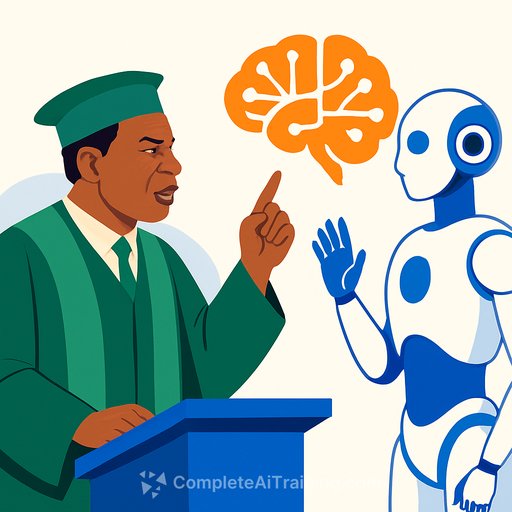
The Director-General of the National Youth Service Corps, Brigadier General Olakunle Nafiu, has urged Nigerian universities to act decisively on Artificial Intelligence. Speaking at the 23rd Convocation of Igbinedion University, Okada, he made the case plain: AI is already changing education. Nigeria can guide that change-or get overtaken by it.
With 60% of Nigerians under 25, the country has a rare demographic advantage. According to the DG, estimates suggest Nigeria's AI market could grow by 27% annually and add up to $15 billion to GDP by 2030. That upside depends on what happens inside lecture halls, labs, and senates over the next few years.
Why this matters for higher education
Evidence from around the world-and even within Edo State-shows AI can improve teaching quality and expand access. It can also make universities more competitive in the Fourth Industrial Revolution. The opportunity is clear; the responsibility is ours.
High-impact use cases for universities
- Personalised learning: Adaptive systems that adjust content, pacing, and feedback for each student.
- Faster research: Tools that assist with literature reviews, data cleaning, coding, and experiment design.
- Access and inclusion: Translation, accessibility features, and low-bandwidth delivery for underserved communities.
- Lean administration: Smarter timetabling, student support triage, assessment workflows, and records management.
The DG also pressed universities to become producers, not just consumers, of technology-building Africa-focused solutions. Priority areas include predictive models for agriculture, diagnostic systems for local diseases, and learning platforms that work in multilingual, infrastructure-limited contexts.
Risks you must address
- Infrastructure gaps: Unreliable power, devices, and connectivity create uneven access and weak outcomes.
- Digital colonialism: Over-reliance on foreign tools can lock institutions into costly, opaque systems.
- Skills shortages: Too few AI-literate lecturers and technicians to support meaningful adoption.
- Ethics and integrity: Misuse in assessment, bias in models, data privacy, and unclear accountability.
- Funding constraints: Capex/Opex needs without clear ROI plans.
To manage these risks, the DG emphasized ethics policies and clear institutional guidelines for AI use-especially for teaching, assessment, and research.
Five strategic actions for Vice-Chancellors and Deans
- Infrastructure: Prioritize stable connectivity, shared device pools, and secure data storage. Start with pilot labs that can scale.
- Curriculum overhaul: Embed AI literacy across disciplines-education, health, agriculture, business, law, and the arts. Teach prompt craft, verification, and model limits.
- Capacity building for lecturers: Run ongoing training and peer-led practice circles. Incentivize classroom experiments and publish what works.
- Governance: Establish an AI in Teaching and Research Committee. Approve tool lists, data policies, assessment rules, and audit processes.
- Equitable access: Provide offline options, device lending, and low-bandwidth tools so students in rural and urban campuses benefit equally.
The NYSC lever
The DG noted NYSC's annual deployment of nearly 400,000 Corps members as a force multiplier. With the right training and toolkits, Corps members can serve as AI literacy ambassadors in schools, libraries, and community centers-bridging gaps in both urban and rural areas.
What you can implement this semester
- Publish a one-page AI use policy for staff and students (assessment, citation, privacy, and misconduct).
- Launch a 6-week microlearning track for lecturers (intro to AI, classroom use, assessment design, research workflows).
- Pick three low-risk pilots: formative feedback assistant, research support in one department, and admin automation for a high-volume process.
- Stand up a small, cross-functional AI task team: ICT, QA, Teaching and Learning, Legal, and two student reps.
- Track outcomes: hours saved, grades improved (formative), access expanded, and staff confidence levels.
Helpful frameworks and guidance
- UNESCO: Generative AI in Education and Research - principles and practical guidance for institutions.
- OECD AI Principles - widely adopted standards for trustworthy AI.
Upskilling pathways for faculty and support staff
If you need a fast way to map roles to practical training, see this curated list of options by job function. Use it to plan faculty development and TA training tracks.
AI courses by job role - Complete AI Training
"AI has already transformed your world; your task is to lead the transformation that comes next."
For universities, that leadership starts with clear policy, focused pilots, and a commitment to building local solutions that serve Nigerian learners and communities.
Your membership also unlocks: