
AI news ·
Employers cannot avoid discrimination liability by using AI hiring tools
A federal court ruled employers using AI hiring tools remain liable for discrimination. Outsourcing to software vendors does not shield companies from anti-discrimination laws.
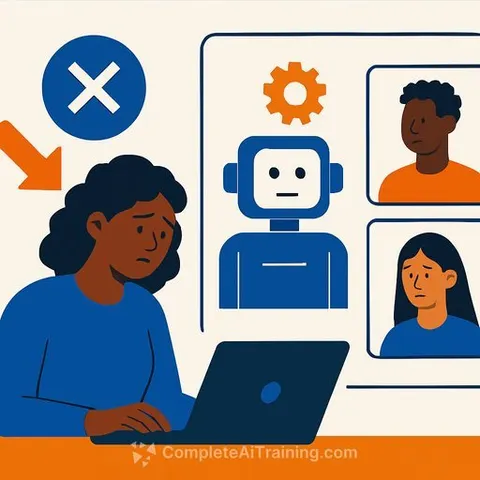
Employers using AI-driven hiring tools face mounting legal scrutiny after a federal court in California ruled that relying on automated decision-making does not shield companies from liability under anti-discrimination laws. The case, Mobley v. Workday, 740 F. Supp3d 796 (N.D. CA 2024), puts companies on notice that outsourcing hiring functions to software vendors carries the same legal risks as using human agents.
AI agents are software programs that make choices and take actions on behalf of an organization. Unlike fixed-rule programs, these agents can learn, adapt, and operate with autonomy-filtering resumes, ranking candidates, or recommending hires without continuous human intervention. When those decisions disproportionately disadvantage applicants based on age, race, sex, disability, or other protected traits, the legal question becomes whether the employer or the vendor bears responsibility.
Agency law governs AI-driven hiring
Courts are applying long-established agency principles to these disputes. If an employer hires a third party to perform hiring tasks, both the employer and the third party can be liable for discriminatory outcomes. Delegating a task does not erase the duty to comply with anti-discrimination statutes. An algorithm that autonomously rejects candidates plays the same functional role as a human screener-and courts have been reluctant to treat the technology as a legal shield. Allowing immunity for AI-driven decisions would, as the court reasoned, create an evasion of civil rights protections and incentivize discriminatory outsourcing.
The core of the issue lies in AI Agents & Automation that exercise independent judgment. When a vendor supplies a neutral tool-say, a spreadsheet that categorizes employees by birthdate-without making selections or recommendations, it typically will not be treated as an agent making hiring decisions. Liability hinges on whether the software provider steps into the decision-maker's role, rather than merely supplying passive utilities used by employers.
Design choices affect legal exposure
AI agents vary by capability and design, and those distinctions matter in litigation. Reactive agents follow fixed rules responsive to inputs and do not learn. Deliberative agents model internal states and plan actions. Learning agents employ machine learning, training on datasets to infer patterns and improve performance. Multi-agent systems coordinate multiple autonomous agents to solve complex tasks. Builders create these agents by defining objectives, choosing architectures, curating training data, and iterating models through validation and deployment. Design choices, data quality, and oversight determine whether an AI agent will operate fairly and lawfully.
Compliance reduces risk
Businesses using AI hiring tools should maintain oversight, vet vendor practices, document decision pathways, and audit outcomes to reduce legal risk and protect applicants' rights. State and federal law can impose liability, and proactive compliance reduces costly litigation while preserving community trust and reputation. For employers in Wyoming and across the country, the message is clear: the technology does not change the legal obligations.
Why this matters for legal professionals
For lawyers advising clients on employment practices or AI for Legal compliance, the Mobley decision confirms that agency law remains the controlling framework. The case signals that courts will look past the technology to the functional role it plays. Legal professionals should be prepared to scrutinize vendor contracts, assess whether an AI tool exercises independent judgment, and help clients build audit trails that demonstrate non-discriminatory outcomes. As AI adoption accelerates, understanding this liability landscape will be essential to effective representation.