Satellites and AI Now Track Ocean Plastic in Real Time
A new program trains European satellites to spot drifting plastic patches and predict where they'll move, giving cleanup teams a window to act before the debris vanishes.
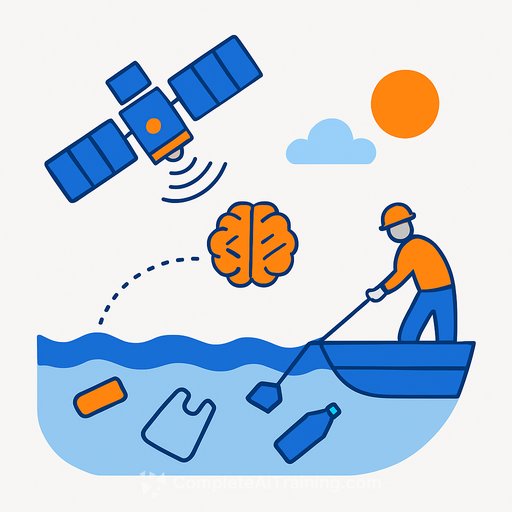
The ADOPT program-short for AI for Detecting Ocean Plastic with Tracking-pairs image recognition software with drift prediction models to help governments and NGOs respond to pollution faster. European Space Agency Sentinel-II satellites equipped with the system can identify garbage patches from space, then calculate where currents will push them within 24 hours.
The two-year project, developed by Swiss and German universities alongside the Swiss Data Science Center, addresses a practical constraint: cleanup operations take time to organize and deploy. By the time teams mobilize, a detected patch may have drifted miles away.
How It Works
Optical sensors on Sentinel-II satellites analyze images to identify plastic debris and extract spectral signatures-the light-reflecting properties that distinguish garbage from natural ocean features. Separate prediction models then forecast drift patterns based on current and wind data.
"One system is to identify garbage patches by analyzing satellite images, and the other is to predict where the patches will have drifted by the time clean-up teams can reach them, usually within 24 hours," said Emanuele Dalsasso, a scientist on the project at Switzerland's École polytechnique fédérale de Lausanne.
The Weather Problem
Clouds disable optical sensors, creating gaps in coverage. Radar-equipped Sentinel-1 satellites can penetrate cloud cover and operate day and night, but they sacrifice the spectral data needed to distinguish plastic from other debris.
Researchers are exploring ways to combine both sensor types, though a complete solution remains unsolved as the initial funding period ended.
Next Steps
The Ocean Cleanup, a Dutch NGO working to remove ocean plastics, is evaluating ADOPT's algorithms for its own operations. The organization has set a target to remove most ocean plastic by 2040.
The program demonstrates how satellite imagery and machine learning can compress response times in environmental cleanup-turning detection into action within hours rather than days.
For professionals working in AI research or data analysis, ADOPT illustrates a practical application of image recognition and predictive modeling beyond consumer-facing products.
Your membership also unlocks: