"Essential, Not Optional": FedEx CEO Makes AI a Strategic Imperative
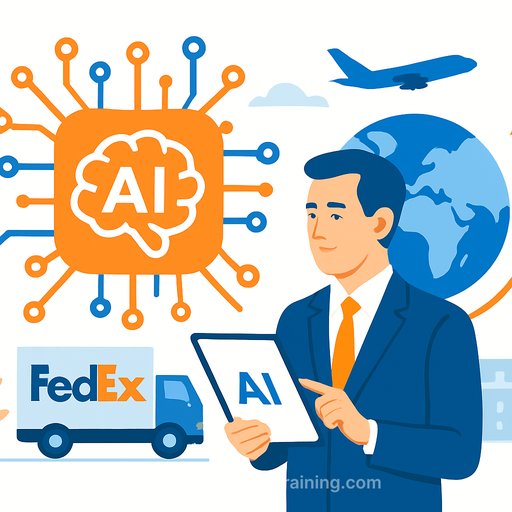
At the AI Impact Summit 2026, Rajesh Subramanian, president and CEO of FedEx, framed artificial intelligence as infrastructure - as fundamental as electricity or the Internet to the future of logistics and global trade.
"The recent explosive growth of AI has the potential to be one of the most significant events in human society since the advancement of electric power systems and the introduction of the Internet," he said. "Building AI capabilities is not optional, it's essential."
Why this matters at the executive level
Subramanian's message is simple: AI is now table stakes for productivity, growth, and network reliability. Treat it as a core capability, not a side project. Companies that operationalize intelligence across their logistics stack will set the pace on cost, service predictability, and risk.
FedEx's playbook: Predict, prevent, and optimize
FedEx is building advanced models to predict supply chain vulnerabilities before they become disruptions. Those models will be trained on the company's massive data footprint - an estimated two petabytes generated every day - to surface risks and opportunities across complex global trade networks.
"Identifying vulnerabilities and addressing them before they become disruptions is probably the most crucial element of supply chain resilience," Subramanian noted. He also pointed to fundamental shifts in trade patterns as the world enters a new phase of re-globalization driven by changing policies - a moving target that demands real-time intelligence.
From pilots to production: Tools already in-market
FedEx isn't waiting on theory. In markets like India, the company has rolled out predictive logistics, automated shipment tracking, and real-time customs updates powered by AI. These capabilities came directly from customer feedback to simplify cross-border workflows.
The aim: convert raw network data into actionable, real-time insights so shippers, carriers, and partners can optimize down to the individual shipment. Think fewer exceptions, faster cycle times, and better promises kept.
Executive actions to operationalize AI now
- Declare AI infrastructure: Treat data, models, and inference as core utilities with funded roadmaps, not experiments.
- Build a risk radar: Stand up predictive analytics for delays, capacity shocks, customs holds, and supplier failure - tied to clear playbooks.
- Close the loop: Connect predictions to automated actions in TMS/WMS/ERP so exceptions trigger workflows, not meetings.
- Modernize data: Unify shipment, sensor, and partner data with standardized APIs and governance you can audit.
- Measure what matters: Track on-time performance, exception rate, lead-time variability, forecast accuracy, and cost-to-serve.
- Design for re-globalization: Model scenario shifts by lane, mode, and policy change to stress-test networks monthly.
- Talent and partners: Blend domain experts with data scientists; selectively partner where scale or data advantage exists.
What to ask your team this quarter
- Where are the top three points of failure in our network, and what model predicts them before they hit customers?
- Which decisions are still manual that should be automated with high-confidence predictions?
- What data do we lack (by region, lane, partner), and what's our plan to close those gaps?
- How are we validating model performance and guarding against drift as trade patterns shift?
AI won't replace sound operations, but it will decide who avoids surprises - and who explains them after the fact. FedEx's direction is clear: anticipate, then act. That's the bar.
For deeper, executive-focused guidance on adoption and governance, see AI for Executives & Strategy. If you lead supply chain transformation, explore the AI Learning Path for Supply Chain Managers.
Watch the full speech here.
Your membership also unlocks: