
AI news ·
Estonia deploys artificial intelligence to catch legal errors following a $28 million drafting mistake
Estonia built an AI tool to review draft laws after one error cost $28 million. The system scans bills against the legal code to flag contradictions before parliament.
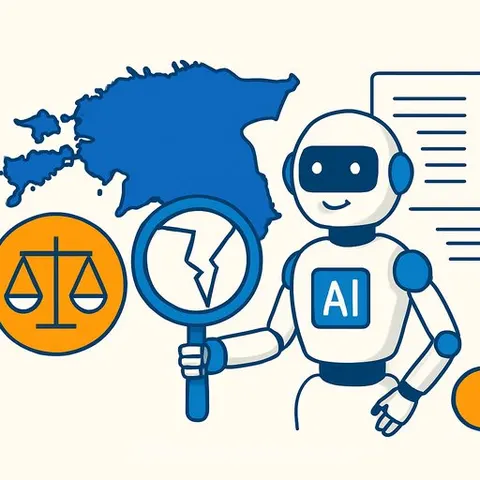
Estonia deployed an artificial intelligence system to review draft legislation for errors after a single drafting mistake cost the government $28 million. The tool, built in response to that oversight, now scans bills against the country's entire legal code before they reach parliament, flagging contradictions and ambiguous language that human reviewers missed.
The mistake was deceptively simple. A misplaced word or poorly structured clause created an unintended legal loophole, according to Wired. Once discovered, that error became the catalyst for building an AI system specifically designed to spot what human eyes overlook-contradictions with existing statutes, vague definitions, and provisions that clash with constitutional requirements.
How the error-detection system works
Internally dubbed the "Fuckup Finder" by developers, the AI performs cross-referential analysis across thousands of pages of legal text. It alerts legislative drafters with specific citations and suggests alternative phrasing when it identifies a potential problem. Early results show the system catching subtle errors that made it past multiple rounds of human review-the kind of issues that only surface when laws are applied in real-world scenarios.
The approach mirrors Estonia's broader digital governance strategy. The country of 1.3 million has spent decades building an e-government infrastructure where citizens vote online and access services digitally. Adding AI to legislative drafting extends that automation to the core work of writing laws, reducing bureaucratic overhead while improving accuracy. This kind of automated review fits into a growing field of AI for Legal applications, though few have been tested at this scale in a national parliament.
Beyond error detection: Automating legislative work
Government officials see the system as a foundation for more complex tasks. They envision AI analyzing policy proposals for unintended consequences, modeling how new regulations will interact with existing frameworks, and even drafting preliminary language for routine legal updates. The goal is augmentation, not replacement-catching mechanical errors so lawyers and policymakers can focus on substantive debates.
The timing is significant. Most government AI experiments focus on customer service chatbots or data analysis. Estonia is testing whether AI can handle high-stakes cognitive work where mistakes carry real financial and legal consequences. If the system proves reliable, it could establish a template for other countries, particularly smaller nations without massive legislative bureaucracies.
Transparency and accountability questions
The deployment raises practical questions. When AI flags a potential error, who decides whether it is a genuine problem or a false positive? How much weight should drafters give the system's recommendations? Estonia is developing protocols for human oversight while avoiding the trap of rubber-stamping whatever the algorithm suggests. The objective is augmented intelligence, not autopilot governance.
The $28 million mistake also highlights a broader truth about legal systems everywhere. They are built by humans, which means they accumulate inconsistencies, outdated references, and contradictory provisions over decades. Most countries lack the resources to systematically audit their entire legal codes. AI could change that equation, making it feasible to maintain legal coherence at scale.
Why this matters for legal professionals
Estonia's experiment tests whether AI can do for legal drafting what compilers did for software development-catch errors before they escape into production. Legal AI has struggled with accuracy issues, including systems that hallucinate case citations or misinterpret statutes. If this tool proves reliable over years of legislative work, it could reshape how democracies write and maintain their laws. For lawyers and legislative drafters, that means watching Estonia closely: a successful deployment would make AI-assisted drafting a standard expectation, not a novelty, and the skills required to work alongside such systems will become part of the profession's core toolkit.