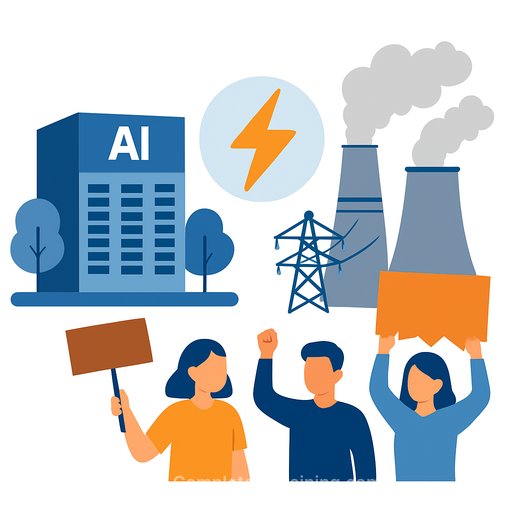
eThekwini's planned AI Data Centre in Amanzimtoti: big promise, bigger questions
eThekwini Municipality is exploring a Memorandum of Agreement (MOA) with the Korea South Power Consortium to develop an AI Data Centre on the KZN South Coast. The proposed site sits within a D'MOSS-sensitive environmental area near the ocean in Amanzimtoti. A local councillor, Andre Beetge, is pushing back on the lack of detail around jobs, energy, water, and environmental impact.
What's on the table
The municipality would provide land and some enabling infrastructure. The developer would fund the building and operations, with a projected outlay of $3 million to $10 million. The stated goal: strengthen smart-city capabilities like traffic optimisation, transport analytics, energy management, and data-driven municipal planning.
Why the pushback
Beetge says councillors saw the MOA just two days before the February 26, 2026 council meeting-raising transparency concerns. He questions whether employment will genuinely favour local talent or lean on imported specialists. He also flags scale and trajectory: the Korean consortium reportedly aims to build 76 facilities globally by 2028, while AI-related electricity demand is surging.
For context, industry estimates point to AI-linked consumption rising from around 415 TWh in 2024 to roughly 945 TWh by 2030. See the IEA's analysis for a broader view of data centre and AI electricity demand trends: IEA outlook on AI-related electricity demand.
Technical unknowns that matter
- Power: No confirmed load, source, or capacity plan. Grid stability is already an issue; the Kingsburgh substation upgrade was reportedly deprioritised.
- Water: No defined demand, sourcing, or treatment plan. Many AI data centres now operate with explicit WUE targets.
- Jobs: No clarity on local hiring, vendor participation, or technology transfer commitments.
- Specs: No confirmed facility design, redundancy level (N+1/2N), heat load, or cooling strategy.
Site-specific risks engineers will care about
- D'MOSS constraints and permitting in a sensitive environmental area near the coastline. Reference background: Durban Metropolitan Open Space System (D'MOSS).
- Corrosive marine environment: materials, coatings, HVAC components, and outdoor switchgear must be specified for salt exposure.
- Railway adjacency: vibration, EMI, construction staging, access, and safety buffers.
- Neighbouring properties: noise (gensets, cooling), light spill, security, and traffic during build and operation.
What the municipality says so far
The MOA is exploratory and allows information exchange and feasibility work with a collective of Korean energy and technology entities. No final decisions have been made on electricity supply, consumption, water demand, or technical design. Any public figures, including megawatt estimates, should be treated as unconfirmed.
If the engagement proceeds, the project would still require full regulatory approvals, including environmental authorisations and water use licences. The municipality states this MOA approval does not constitute:
- Approval of the project itself
- Approval of infrastructure commitments
- Approval of financial contributions
- Confirmation of technical specifications
- Approval of regulatory or statutory authorisations
Key questions raised by Councillor Andre Beetge
- Are building materials and coatings specified for corrosive coastal conditions?
- What's the impact on the adjacent railway line and required mitigation?
- How will neighbouring private properties be protected from noise, traffic, and security risks?
- What environmental mitigation measures are proposed for a D'MOSS-sensitive site?
- What is the facility's water consumption profile, and how will it be supplied and treated?
Practical checklist for IT, DevOps, and infra teams
- Energy plan
- Define peak/average MW, redundancy (N+1/2N), and PUE targets under coastal conditions.
- Model grid constraints, substation capacity, and timelines; evaluate on-site generation, BESS, and PPAs.
- Commit to emissions accounting, including backup fuel use and demand-response participation.
- Thermal and water strategy
- Publish cooling architecture (air, liquid, rear-door, immersion) and expected WUE.
- Plan for water sourcing, treatment, discharge, and drought contingencies.
- Assess heat reuse options for nearby municipal loads.
- Resilience and coastal engineering
- Salt fog standards, corrosion-resistant bill of materials, and maintenance cycles.
- Flood, storm surge, and wind-loading assessments; elevation of critical equipment.
- Railway vibration/EMI mitigation and construction-phase safety plans.
- Network and compute
- Diverse fibre routes, SLA-backed latency, and peering strategy for AI workloads.
- GPU/accelerator density, rack power (kW/rack), and liquid-ready designs.
- DCIM integration with real-time energy, thermal, and sustainability telemetry.
- Local participation and governance
- Local hiring targets, vendor quotas, and skills transfer plans with measurable KPIs.
- Transparent public participation, EIA publication, and issue-tracking for community feedback.
- Clear procurement rules to prevent exclusive reliance on imported specialist labour.
What "good" could look like if this proceeds
- A verified feasibility study with disclosed load, water, and environmental baselines.
- Binding commitments on local jobs, training pipelines, and SME supplier development.
- Grid interconnection plan with staged capacity, plus on-site generation and storage for resilience.
- Design optimised for coastal risks, with published maintenance and corrosion mitigation schedules.
- Transparent monitoring of PUE, WUE, uptime, and community impact with quarterly reporting.
Bottom line
The opportunity is real, but so are the risks-especially for power, water, and a sensitive coastal site. The municipality frames this MOA as a first step, not approval. For this to earn technical and public trust, the next move should be a concrete feasibility pack that answers the hard questions above, backed by measurable local participation and environmental safeguards.
For deeper context on infrastructure and operations in AI-heavy environments, see AI for IT & Development.
Your membership also unlocks: