EU AI Act: Draft Standard Puts Quality Management Front and Center
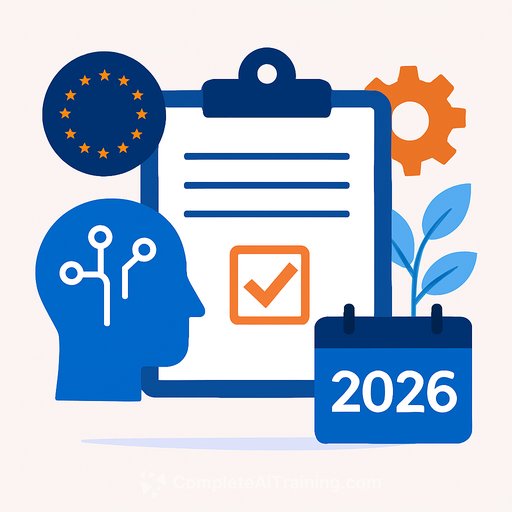
The first EU standard to support conformity with the AI Act is out in draft. It targets one thing: the quality management regime required by Article 17. It's already circulating for feedback across member countries, with publication expected by the end of 2026.
CEN and CENELEC, the EU standardization bodies, announced on Oct 30 a set of measures to speed this along. Translation: pace matters, and enforcement will lean on this standard once finalized.
Why managers should care
Harmonized standards are the fastest route to a presumption of conformity in the EU. If your products or internal tools include high-risk AI, this draft is your playbook for passing audits with less friction and fewer surprises.
Waiting until the standard is final will cost time, money, and leverage. Start now and you'll control the timeline-not the other way around.
Article 17 in plain terms
Article 17 requires providers of high-risk AI systems to implement a quality management system (QMS) across the product lifecycle. Think ISO-style discipline adapted to AI.
- Clear governance: executive accountability, roles, and decision rights
- Risk management: identify, assess, and treat AI risks before and after release
- Data and model controls: sourcing, labeling, testing, and change tracking
- Technical documentation: complete, current, and audit-ready
- Human oversight: defined procedures, escalation paths, and training
- Post-market monitoring: logs, performance checks, and incident handling
- Supplier management: requirements, due diligence, and flow-down clauses
- Security and reliability: resilience, access control, and fallback strategies
- Record-keeping: traceability across design, training, validation, and updates
What the draft standard likely adds
Operational detail-how to prove you did the work. Expect control objectives, process expectations, documentation structures, and audit evidence examples. That's the difference between good intentions and passing a conformity assessment.
90-day action plan
- Appoint an executive owner and a cross-functional AI QMS lead.
- Inventory AI systems and map them to EU AI Act risk categories.
- Run a gap assessment against Article 17 requirements.
- Stand up core QMS processes: risk management, data governance, change control, incident response, and post-market monitoring.
- Define supplier requirements and update contracts to include AI Act obligations.
- Start the technical documentation backbone: system purpose, data lineage, model specs, validation results, monitoring plan.
- Pilot one end-to-end conformity "dry run" on a priority high-risk system.
Documentation you'll be asked for
- AI inventory and risk classification rationale
- Risk management files and validation reports
- Data sourcing, preprocessing, and labeling controls
- Model versioning, training parameters, and test coverage
- Human oversight procedures and training records
- Supplier due diligence and flow-down requirements
- Post-market monitoring plan, logging strategy, and incident playbooks
- Management review minutes and corrective actions
Vendor and procurement guardrails
- Demand transparency: model cards or equivalent artifacts, evaluation results, update cadence
- Flow down obligations: logging, incident reporting, security, and data provenance
- Right-to-audit or third-party assurance aligned to the EU AI Act
- Change notification terms for material updates impacting risk
Metrics that make audits easier
- Performance stability across versions (accuracy, drift, error rates)
- Fairness and impact metrics relevant to the use case
- Oversight effectiveness: intervention frequency and outcomes
- Incident response timing and closure quality
- Data quality checks and revalidation coverage
Budget and resourcing
- Dedicated QMS lead plus embedded process owners in product, data, security, and legal
- Tooling: experiment tracking, model registry, monitoring, and logging
- Independent testing capacity (internal or third-party)
- Training for teams on Article 17 and audit evidence
Common mistakes to avoid
- Treating QMS as paperwork-auditors test behavior, not just binders
- Incomplete inventory-missing shadow AI or vendor-supplied components
- Weak change control-models evolve faster than the documentation
- No post-market loop-issues surface after deployment, not before
- Single-threaded ownership-this is cross-functional by design
Timeline signals
The draft is circulating now, with publication targeted by end of 2026. CEN and CENELEC have stated speed is a priority. That's your cue to operationalize Article 17 ahead of the final text and treat updates as iterations, not rework.
Useful references
Want training for your team?
If you're standing up an AI QMS or prepping for audits, focused skill-building helps. Explore role-based programs and certifications here:
Bottom line: the draft standard turns Article 17 from principle into process. Start building the system now, and you'll be ready when enforcement asks for proof.
Your membership also unlocks: