AI Adoption in the EU: Usage, Education, and Business Trends in 2025
Date: January 25, 2026 at 4:00 PM GMT+8
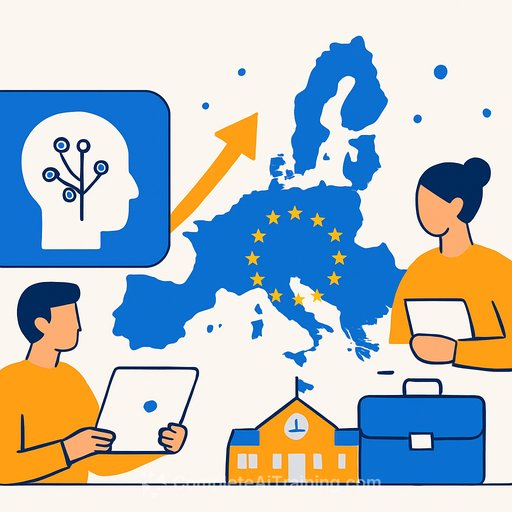
The EU is moving on three fronts: funding adoption, building preparedness, and publishing ethical guidance for AI use. A recent Eurobarometer shows 64% of Europeans expect AI literacy to be essential by 2030. Since 2021, enterprise AI use has grown by 12.30%, and 32.7% of individuals report using AI tools. OpenAI reported 120.4 million active users in the EU in 2025, with ChatGPT holding 80.02% of the market; the rest is split across Perplexity, Microsoft Copilot, Google Gemini, and Claude.
What this means for educators
Adoption is uneven across Member States, and that carries straight into classrooms. Your job isn't to chase every new tool; it's to set clear rules, raise baseline skills, and apply AI where it actually improves learning. Focus on safe tools, age-appropriate use, and measurable outcomes - and consider the AI Learning Path for Primary School Teachers for role-specific, age-appropriate training and classroom templates.
Education use in 2025: low, uneven, and politicized
Only 9.8% of Europeans on average use generative AI for formal education. Lowest reported use: Hungary (0.62%), Romania (3.37%), Poland (4.59%), Bulgaria (5.17%), Germany (6.04%). Leaders: Sweden (20.99%), Malta (20.22%), Denmark (17.86%), Spain (16.26%), Estonia (15.41%).
Per Eurobarometer, 54% see both benefits and risks for classrooms, while 22% say AI doesn't belong there. Two gaps need fast action: safe, age-appropriate tools for learners, and targeted support for educators teaching students with learning difficulties.
- Publish a simple AI use policy for students and staff (what's allowed, how to cite AI use, consequences).
- Map AI to outcomes: feedback quality, time saved in planning/grading, differentiation for diverse learners.
- Vet a short list of approved tools with age gates and data protections. Run pilots before scale-up.
- Build staff skill in prompt practice and critique, not tool-hopping.
Reference sources: Eurobarometer and the EU's Ethics Guidelines for Trustworthy AI.
Work and private use: signals for career readiness and digital citizenship
15.07% of Europeans use generative AI for work. Lowest: Hungary (1.31%), Romania (5.24%), Italy (8.00%), Poland (8.36%), Bulgaria (8.43%). Highest: Malta (29.64%), Denmark (27.17%), Netherlands (26.56%), Estonia (25.12%), Finland (25.11%). This is the job market your learners will enter.
Private use is higher and more open: Cyprus (43.13%), Greece (40.91%), Estonia (37.47%), Malta (37.20%), Luxembourg (35.71%). Lowest: Hungary (2.12%), Italy (12.81%), Romania (14.85%), Poland (19.13%), Bulgaria (20.15%). Teach responsible personal use, attribution, and source-checking as standard practice.
Business adoption: why it matters for curricula
On average, 19.95% of EU businesses use at least one AI technology. Highest: Denmark (42.03%), Finland (37.82%), Sweden (35.04%), Belgium (34.54%), Luxembourg (33.61%). Lowest: Romania (5.21%), Poland (8.36%), Bulgaria (8.55%), Greece (8.93%), Cyprus (9.27%). The message: AI is now routine in a meaningful share of firms, especially in Northern Europe.
- Design sector-based projects (health, logistics, finance, public services) that use AI for analysis, writing, or prototyping.
- Teach prompt critique, source validation, bias checks, and basic data literacy.
- Blend AI with communication skills - clear writing and presentation amplify AI outputs.
Managers responsible for implementation and team readiness can use the AI Learning Path for Business Unit Managers to align training with sector needs and operational priorities.
Tooling reality check
ChatGPT holds 80.02% share in Europe, but alternatives matter for backup, compliance, and pedagogy. Pick a small stack and create a simple evaluation rubric so teachers aren't guessing.
- Privacy: data retention, EU hosting options, export controls, and DPIA readiness.
- Safety: age gating, moderation, and bias safeguards that you can explain to parents.
- Access: cost, multilingual support, accessibility features, and audit logs for academic integrity.
Equity across Member States
Some countries treat generative AI as normal; others avoid it. Plan for both realities and build bridges so students aren't left behind due to postcode.
- If your country's uptake is low: start with staff-only pilots, parent communication, and a narrow set of safe tools.
- If your uptake is high: standardize academic integrity workflows, scale teacher communities of practice, and track impact data.
KPIs schools and ministries can track now
- Student AI literacy baseline and endline each term.
- Hours of teacher PD completed and classroom adoption rate by subject.
- Approved tool list coverage by age band and accommodations for learning difficulties.
- Academic integrity: percentage of assignments with declared AI use and audit outcomes.
- Time saved in planning/grading and documented improvements in feedback quality.
Where to skill up fast
If you need structured options to train staff by role and skill, see the course collections here: Complete AI Training - Courses by Job. Start with prompt practice and classroom-use templates, then build out tool-specific depth as needed.
Policy note
The EU's AI Continent Action plan and Apply AI strategy point in the right direction. The next step is practical: sector-level guidance, business-process detail, and KPIs by Member State, business size, and AI maturity. Schools can mirror that approach - clear use cases, measurable outcomes, and transparent safeguards.
Your membership also unlocks: