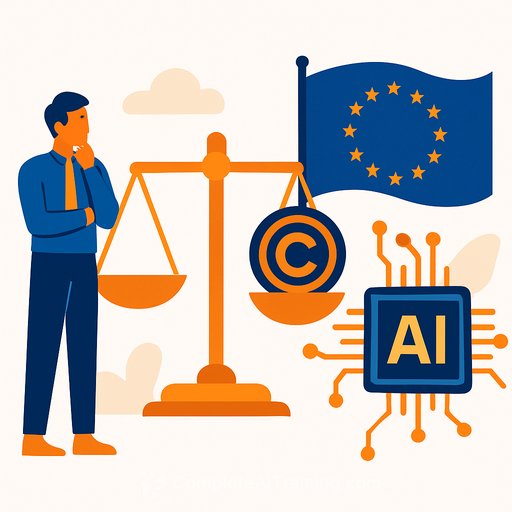
MEP Axel Voss Urges Immediate Review of EU Copyright Law for AI
Axel Voss, Member of the European Parliament (MEP), called on the European Commission to urgently evaluate whether current EU copyright law sufficiently addresses the legal uncertainties and competitive impacts arising from AI companies training their generative models using existing copyrighted content.
His remarks came during a session of the European Parliament’s legal affairs committee, following the release of a report commissioned by the committee. The report challenges the assumption that the EU’s 'text and data mining' (TDM) exception covers the training of generative AI, a stance currently under consideration by the UK government for its own copyright framework.
The Limits of the EU TDM Exception
The TDM exception, originating from Article 4 of the 2019 EU Copyright Directive, allows AI companies to use copyrighted works for training without explicit permission, provided rightsholders have not opted out. However, the report, authored by Spanish law professor Nicola Lucchi, clarifies that the exception was intended for data mining aimed at extracting patterns, trends, or factual correlations, primarily for scientific research and data analysis.
Lucchi explains that generative AI training fundamentally differs from this use. Instead of merely identifying semantic content or factual correlations, these AI systems absorb, encode, and recombine stylistic, structural, and expressive features of copyrighted works. Context within the directive indicates that Article 4 was not drafted with such AI applications in mind.
Seeking a Balanced Approach
Voss, who has also published his own paper on copyright and AI, emphasized the need for a balanced solution that protects copyright owners’ rights while supporting AI development. He suggests that a new, AI-specific copyright exception may be necessary, as the current TDM clause is inadequate for addressing generative AI’s unique challenges.
From the perspective of creators and copyright owners, including those in the music industry, the preference is clear: no exception should allow generative AI training without permission and appropriate licensing fees. This stance aligns with the report’s conclusion that the existing TDM exception does not apply to generative AI, a finding that resonates with the music community.
Legal Support for Copyright Holders
The report’s conclusions are reinforced by similar developments in the United States. Earlier this year, the US Copyright Office determined that the ‘fair use’ doctrine does not automatically apply to AI training, strengthening the position of copyright holders seeking licensing agreements with AI companies.
Lucchi also addresses a common defense from AI companies: that AI training resembles how humans consume and learn from existing creative works. Under EU law, this analogy falls short. Unlike human authors who understand and reinterpret ideas, AI systems operate without comprehension, following statistical patterns rather than engaging with meaning.
She cites philosopher Luciano Floridi to underline this distinction: “AI acts without understanding.” This difference is key legally, as humans can restate ideas without infringing copyright, but AI must copy and recombine protected content to function. Even if the AI’s output appears original, the act of using copyrighted material for training is considered reproduction and may require permission unless a specific legal exception applies.
Implications for Legal Professionals
- Current EU copyright law, specifically the TDM exception, does not clearly cover generative AI training.
- Legislators may need to introduce new, AI-specific copyright exceptions or revise existing provisions.
- Rights holders, particularly in creative industries like music, are positioned to demand licensing agreements from AI developers.
- The legal distinction between human creativity and AI processing affects how copyright infringement is assessed.
Legal professionals advising clients in the AI and creative sectors should monitor these developments closely. Understanding the evolving interpretation of copyright exceptions in relation to AI training is critical for navigating licensing negotiations and compliance strategies.
For those seeking to expand their expertise in AI and legal frameworks, resources such as Complete AI Training’s legal courses provide practical insights into AI’s impact on intellectual property law.
Your membership also unlocks: