EU launches AI whistleblower tool - but legal protections lag until August 2026
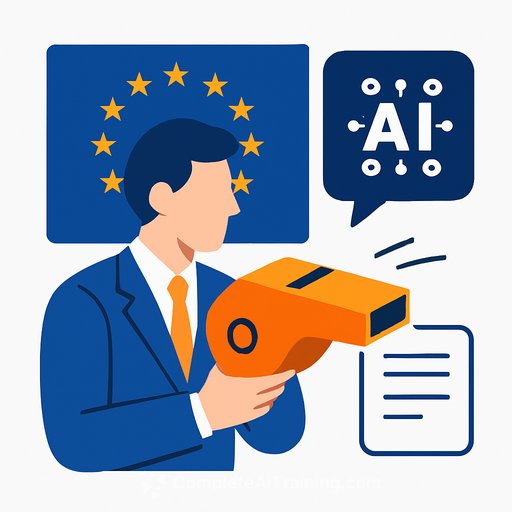
The European Commission has released a confidential channel for insiders at AI model developers to report suspected breaches of the EU's AI rules. The tool promises strong encryption and security measures, yet it clearly warns: "currently, there is no legal protection against retaliation by your employer."
Key point for counsel: the AI Act's explicit link to EU whistleblower protections won't apply until August 2026. That creates a real exposure window for reporters-and a compliance challenge for companies-over the next year.
What the tool offers
The channel is built for employees and contractors who believe their organization is violating the AI rulebook. It accepts tips confidentially and signals serious intent from EU institutions to surface early, inside-the-company signals of non-compliance.
Karl Koch, founder of the AI whistleblower initiative, called the move "an incredibly valuable step," noting it's the first channel of its kind and that the Commission engaged outside expertise while building it.
The protection gap
The EU Whistleblower Directive already protects reporting on certain breaches of EU law, including product safety. Since the AI Act functions as a product safety framework, some AI issues may be arguable under existing protections today-but it's not a sure bet, and outcomes will depend on facts, forum, and counsel.
The catch: the AI Act provision that clarifies applicability of whistleblower protections does not kick in until the second half of 2026. Until then, reporters face legal uncertainty if their identity becomes known. The Commission is upfront about this, even as it emphasizes technical safeguards.
Comparative note: SEC experience
Koch pointed to the U.S. SEC's program as precedent: a material share of awards went to non-U.S. reporters the SEC cannot legally protect from employer retaliation. The program leaned heavily on confidentiality to mitigate that risk-an approach the EU tool appears to adopt as well.
Implications for legal and compliance teams
- Map the risk window now through August 2026. Assume external reporting could occur without guaranteed protection for the reporter, which heightens retaliation risk allegations and PR exposure if mishandled.
- Strengthen internal reporting channels specific to AI issues. Offer anonymous options, rapid triage, clear non-retaliation statements, and documented escalation paths to counsel.
- Review NDAs, codes of conduct, and investigation SOPs. Ensure carve-outs for lawful reporting to authorities, and tighten trade secret handling to prevent over-collection of sensitive data.
- Train managers and HR on non-retaliation and documentation hygiene. Small missteps (scheduling, performance feedback timing, access changes) can be framed as retaliatory.
- Stand up an AI Act incident playbook: define what constitutes an "AI breach," evidence preservation, privilege strategy, cross-border data considerations, and regulator engagement.
- Coordinate with works councils and DPOs where applicable. Align internal reporting with privacy, employment, and works council information requirements.
- For multinationals, map jurisdictional overlays (national whistleblower transposition, labor law, trade secrets) and pre-clear outside counsel in key countries.
Guidance if you advise potential whistleblowers
- Clarify the protection gap and forum options before any disclosure. Scope what can be shared lawfully and how to minimize trade secret exposure.
- Use secure channels and reduce digital footprints where possible, consistent with law and employment obligations. Keep contemporaneous notes.
- Consider sequencing: internal report vs. external channel, and whether internal mechanisms are credible and safe in the specific organization.
Key references
EU AI Act overview: European Commission - EU AI Act
EU Whistleblower Directive: Directive (EU) 2019/1937
Bottom line: the channel is open, the legal backstop arrives in August 2026, and the prudent move-whether you're advising companies or individuals-is to tighten process, document intent, and reduce avoidable risk today.
Your membership also unlocks: