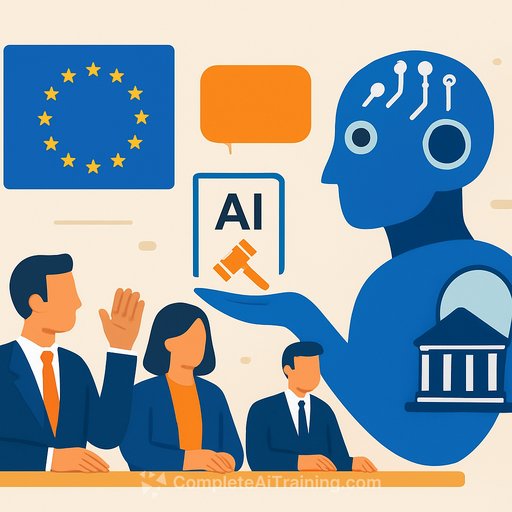
EU legislation: Parliament's Legal Affairs Committee backs AI tools in lawmaking
Europe's Legal Affairs Committee has called for the use of AI tools in the EU legislative process. An own-initiative report from Jörgen Warborn (EPP) won broad support in committee and is expected to move to a plenary vote soon.
The goal is straightforward: make EU legislation more professional and efficient without losing legal certainty or democratic control. For legal teams, this is a signal to prepare for AI-enabled drafting, review, and oversight becoming standard across Brussels.
What's on the table
- Pro-innovation stance: Formal encouragement to use AI tools across parts of the legislative workflow.
- Quality and consistency: Better structure, fewer drafting errors, and tighter alignment across multilingual versions.
- Next step: Plenary vote in the European Parliament. If adopted, expect follow-up guidance and internal standards.
Why legal teams should care
- Speed and volume: AI can flag inconsistencies, surface precedent, and streamline amendments-useful in fast-moving files.
- Traceability expectations: If institutions use AI, they'll expect stakeholders to match that precision with clear citations and audit trails.
- Procurement and vendor risk: Tools that touch legislative drafts will face scrutiny on confidentiality, IP, and data protection.
Governance likely in scope
- Human oversight by default: Final drafting and legal checks remain a human responsibility.
- Transparency: Clear indication of when and how AI contributed to a text or analysis.
- Data protection and confidentiality: No sensitive or restricted data in consumer-grade tools; strict access controls.
- Bias and quality controls: Regular evaluations, versioning, and documented methodologies.
- Security and IP: On-prem or EU-hosted options where needed; contracts that protect source materials and outputs.
Practical steps to prepare now
- Set a policy: Define approved AI use cases (draft checks, citations, Translation) and banned ones (sensitive data, final drafting).
- Pilot safely: Start with non-personal, public legislative texts; maintain red-teaming and human review.
- Documentation: Log prompts, versions, and sources to preserve explainability for clients and regulators.
- Tool standards: Require enterprise features: encryption, retention controls, SOC 2/ISO 27001, EU data residency if relevant.
- Contracting: Update NDAs, engagement letters, and vendor terms to cover AI usage, confidentiality, and liability.
- Training: Build prompt and review skills for associates and policy teams; pair AI outputs with authoritative citations.
Timeline and what to watch
- Parliament vote: Track the plenary decision and any amendments that narrow or expand permitted use cases.
- Implementation guidance: Watch the Legal Affairs Committee and Parliament administration for operational rules, tooling choices, and disclosure formats.
- Alignment with Better Regulation: Expect AI practices to intersect with existing quality standards and impact assessment routines.
Authoritative resources:
If your team needs structured upskilling on practical AI workflows for drafting and review, see our curated options by role: Complete AI Training - Courses by Job.
Date: 29 January 2026
Get Daily AI News
Your membership also unlocks:
700+ AI Courses
700+ Certifications
Personalized AI Learning Plan
6500+ AI Tools (no Ads)
Daily AI News by job industry (no Ads)