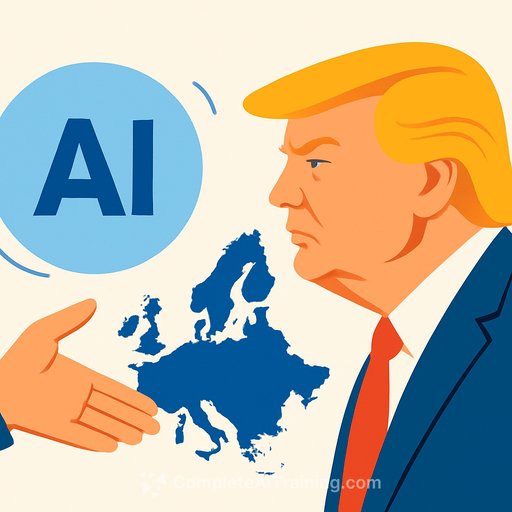
Europe's Hidden Leverage Over America's AI Boom
AI spending now sits at the center of US market confidence and growth narratives. That makes two things unusually important: who controls the AI hardware pipeline and who controls the data that trains the models.
Europe touches both. One lever is industrial. The other is regulatory. Either one, if applied firmly, could reset expectations for US tech and the broader economy.
Lever 1: The Lithography Chokepoint
A single Dutch company, ASML, supplies the advanced lithography tools needed to fabricate the most capable chips. Without these machines, output at the leading edge slows, and the AI build-out hits friction across GPUs, servers, and data centers.
Export policy here is a macro lever. Tightening or delaying access to specific systems or services-whether bound for US fabs or Asian foundries-would ripple through inventory, pricing, and deployment timelines. That translates into pressure on AI roadmaps and the valuations built on them.
- Short-term effects: bottlenecks in GPU availability, delayed data center upgrades, higher compute costs.
- Medium-term effects: supply chain rewiring, potential retaliatory trade moves, spillovers into automotive, telecommunications, and defense electronics.
- European exposure: concentrated impact in the Netherlands and supplier ecosystems across Germany and Central Europe.
More on how these machines work can be found at ASML's overview.
Lever 2: Enforcing Data Protection at Scale
Large AI models are trained on vast amounts of data. In the EU, personal data use is tightly governed under the GDPR: purpose limitation, lawfulness, transparency, and demonstrable accountability are not optional.
Uniform, assertive enforcement-especially where most big tech firms base their EU operations-would force major platforms to rebuild data intake, retention, and access controls. It could also restrict certain training datasets until compliance is proven, limiting product rollout and usage in the European market.
- Technical impact: retraining models, re-engineering pipelines, stricter audit trails, and access governance.
- Market impact: delayed feature launches, narrowed data access for product improvements, and greater legal exposure.
- Investor impact: repricing based on compliance costs and slower monetization in Europe.
For the legal baseline, see the European Commission's page on EU data protection rules.
What This Means for Transatlantic Policy
Because AI is now intertwined with growth expectations, even modest European moves can change sentiment. That's leverage-economic, regulatory, and political.
But leverage cuts both ways. Any action invites countermoves: tariffs, procurement preferences, or constraints on European firms operating in the US. The question is not whether Europe has leverage. It's how precisely to use it, and at what cost.
Key Considerations Before Pulling Either Lever
- Economic spillovers: How would export restrictions or hardline enforcement affect European suppliers, employment, and capital expenditure?
- Allied coordination: Are member states aligned, and can positions be sustained under diplomatic and market pressure?
- Legal durability: Will measures withstand challenges in EU courts and international trade forums?
- Security balance: Could tighter export controls accelerate alternate supply chains outside Europe's influence?
- Consumer impact: Will service disruptions or product delays harm European users or small businesses?
Signals to Watch
- Export licensing changes in the Netherlands and EU-level coordination on semiconductor tools.
- Enforcement actions by EU data protection authorities, especially involving model training and cross-border transfers.
- Disclosures from major chip and cloud providers on lead times, capex, and data governance controls.
- Trade measures or negotiations that reference semiconductors or digital services.
Bottom Line
Europe sits on two pressure points that matter for AI: the tools that make the chips, and the rules that govern the data. Either path can reshape timelines, valuations, and negotiations across the Atlantic.
The smart move is clarity: clear criteria, predictable timelines, and measurable compliance paths. That keeps options open, reduces unintended blowback, and shows that leverage is being used with precision, not impulse.
Your membership also unlocks: