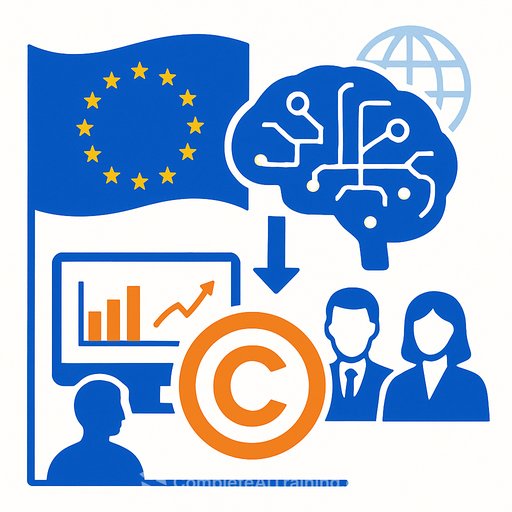
EU Parliament Signals Major Shift on AI Training and Copyright
The European Parliament adopted a non-binding resolution on March 10, 2026, that could reshape how AI developers worldwide source training data. The resolution suggests the EU may expand its copyright rules to apply whenever AI systems are offered in Europe-regardless of where they were built. For U.S. companies and other non-EU AI providers, the implications are direct: compliance with European copyright law may soon depend on factors beyond their home jurisdiction.
The resolution itself carries no legal force. But it reflects a political consensus within EU institutions that traditional copyright law cannot adequately address generative AI training. The underlying committee report goes further, proposing a flat-rate licensing fee of 5 to 7% of global turnover to compensate European creators whose work was used to train AI models.
The Problem: AI Training Doesn't Fit Old Copyright Rules
European copyright law developed to protect individual creative works from unauthorized copying and distribution. It assumes copying is identifiable and controllable. Generative AI operates differently. These systems process billions of digital copies of texts, images, audio, and video to identify patterns and generate new outputs. The training process itself doesn't distribute the original works-it analyzes them computationally.
This distinction matters legally. Many in Europe argue that the EU's text-and-data-mining exception-added to copyright law in 2019-was never intended to cover large-scale AI model training. Courts across Europe have reached conflicting conclusions. In November 2025, a Munich court ruled that certain AI training constituted copyright infringement. That same month, a London court dismissed a similar claim, finding the training did not infringe copyright under applicable law.
The economic stakes are high. Generative AI now powers business operations across industries. But much of the training data comes from European journalists, photographers, musicians, filmmakers, and publishers-creators who typically received no authorization or compensation.
What the Resolution Proposes
Opt-out registries. The resolution suggests creating machine-readable opt-out mechanisms so rights holders can signal their content should not be used for AI training. A centralized European register maintained by the EU Intellectual Property Office (EUIPO) could record these signals, forcing AI developers to check before training.
Transparency requirements. AI developers would disclose more information about copyrighted materials used in training. This information could be reported to EUIPO, which would serve as a contact point for rights holders and monitor compliance.
Shifted burden of proof. The resolution discusses introducing a rebuttable presumption: if AI providers fail to meet transparency obligations, their models are presumed to contain copyrighted works unless proven otherwise. This significantly favors rights holders in litigation by lowering their evidentiary burden.
Licensing fees. The committee report proposes a flat-rate fee of 5 to 7% of global turnover as compensation. The language suggests this could apply retroactively to training already completed.
Territorial Reach: The Global Implication
The most significant proposal breaks from traditional copyright doctrine. Historically, copyright protection has followed territoriality-each jurisdiction applies its own rules to acts within its borders. The resolution suggests the EU should apply its copyright rules whenever an AI system is offered to European users, regardless of where it was trained.
This means a model trained entirely in the United States or Asia could trigger EU copyright obligations if made available to Europeans. The stated goal is to create a level playing field between European and non-European providers. The practical effect is to extend EU regulatory reach beyond its borders.
Such an approach could conflict with legal regimes elsewhere. U.S. copyright law and fair use doctrine take different views on training data use. Jurisdictions may increasingly require companies to operate under conflicting standards depending on where their systems are deployed.
What Happens Next
The resolution does not create binding law. The European Commission must propose legislation before rules take effect. But parliamentary resolutions frequently signal future regulatory direction. Companies should monitor developments closely.
For AI developers, service providers, and enterprise users, the emerging framework raises practical questions: How should training data sources be documented? What mechanisms ensure compliance with rights-holder opt-outs? Who bears copyright liability-foundation model developers, application developers, or downstream users?
The EU's approach will likely intersect with other regulations. The EU AI Act already imposes requirements on high-risk AI systems. GDPR governs data processing. If copyright rules are added, companies may face multiple, potentially conflicting requirements across jurisdictions.
U.S. technology companies operating in Europe should assess how their AI systems interact with European copyright law, document training data sources, and evaluate governance frameworks for the emerging regulatory environment. The supply chain for generative AI-from dataset providers to foundation model developers to application builders to end users-will need to clarify how copyright liability flows through each actor.
The European debate is moving beyond classical copyright toward broader data governance for AI training. For globally operating companies, navigating multiple legal regimes will likely become central to technology compliance strategy.
Read the JURI Committee Report and European Parliament Resolution.
For legal professionals navigating AI compliance, AI for Legal covers practical applications in legal research, document review, and contract analysis-areas directly affected by these copyright and AI training developments.
Your membership also unlocks: