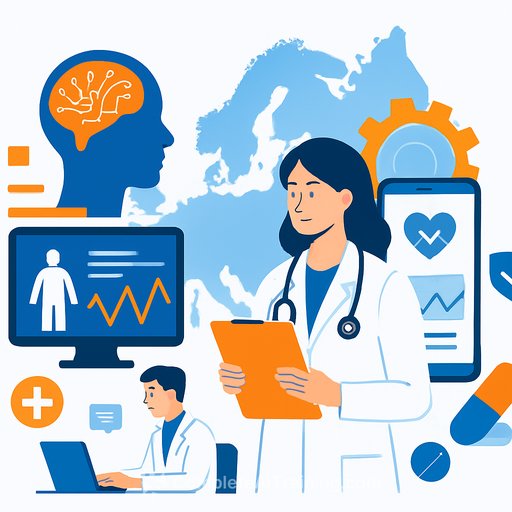
AI in European Healthcare 2025: Diagnosis, Monitoring & Administrative Aid
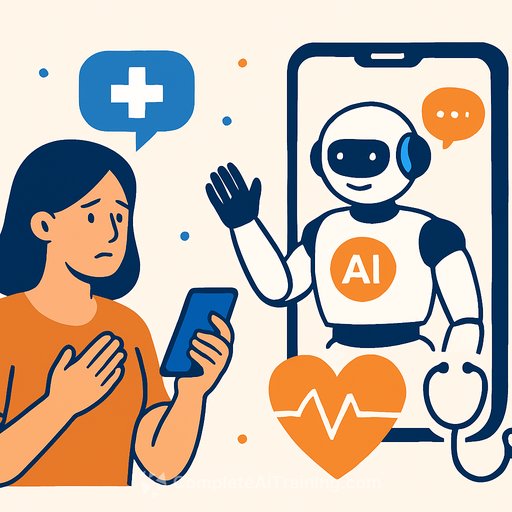
Across Europe, AI moved from promise to practice in 2025. Hospitals and clinics are using it to speed up diagnoses, sharpen risk prediction, and reduce paperwork-while keeping clinicians in the driver's seat.
The takeaway for healthcare teams: use AI where it reliably augments clinical work. Keep human oversight in acute care, mental health, and any setting where nuance and context decide outcomes.
Where AI Helps Today-and Where It Doesn't
- Deployment is real: Finland, Estonia, and Spain are applying AI to train staff, analyze datasets, and detect disease earlier.
- Clinicians still outperform AI in emergencies: Research shows doctors make better decisions under pressure; chatbots stumble with mental health and can spread misinformation.
- Security risk isn't theoretical: Experts warn extremists could misuse AI to design biothreats. Governance and access controls matter.
Predicting Future Illness
Scientists built an AI model that forecasts over 1,000 conditions-some cancers, heart attacks, diabetes-more than a decade before a formal diagnosis. It's not ready for the clinic yet, but it's a strong research tool for studying disease trajectories; see AI Research Resources for training materials and methods that support this kind of work.
Other launches this year: models that estimate if rare mutations are pathogenic, mammogram-based tools that flag women at risk for cardiac events, and imaging models that pick up stress biomarkers from routine scans.
- Practical use now: Research cohorts, risk registries, and protocol design.
- Prepare for adoption: Validate on local populations, set thresholds with clinicians, and predefine escalation rules.
Assisting with Diagnosis
In a European first, an AI assistant named Prof. Valmed earned certification to support doctors on diagnosis and treatment using large patient datasets.
In the UK, an AI stethoscope can flag certain heart conditions in about 15 seconds. It's sensitive-sometimes too sensitive-but it surfaced real cases that might have been missed. UK clinicians are also using AI to triage prostate imaging, pushing high-risk cases to the front of the review queue.
- What to watch: False positives, workflow fit, and how often AI changes management.
- Governance: Keep clinical sign-off, document overrides, and track performance drift.
Monitoring Heart Health
A German team automated post-stent follow-up with AI that reads vessel imaging to classify healing patterns. Accuracy matched expert readers and offered consistent, rapid assessments.
- Operational value: Standardization across sites, faster reviews, and clearer criteria for revascularization decisions.
- Implementation: Integrate with OCT/IVUS, enforce image quality checks, and set alert pathways.
Fighting Superbugs
Researchers are building AI models to design and test new treatments for drug-resistant bacteria and to map immune responses that could inform vaccine development over the next three years.
- Near-term steps: Partner with microbiology labs, pool de-identified data, and align with stewardship programs to preserve antibiotic efficacy.
Managing Administrative Tasks
Clinics are rolling out AI tools for documentation and referrals to return time to patient care. Microsoft introduced its clinical assistant in Ireland. Tandem Health launched an AI medical scribe in Spain, Germany, the UK, Finland, the Netherlands, Norway, and Denmark.
- Pilot smart: Start with one specialty, compare note quality and time saved, and secure patient consent.
- Privacy: Keep PHI encryption end-to-end, restrict data retention, and vet vendors for compliance.
Safety, Compliance, and Risk
- Use certified tools: Check CE marking for medical software and document intended use.
- Monitor bias and drift: Review performance by age, sex, and ethnicity; retrain or recalibrate as needed.
- Log outcomes: Track adverse events, overrides, and AI-to-clinician disagreement.
- Regulatory awareness: Stay current with EU AI and medical device rules. See the European Commission's guidance on AI policy here.
- Ethics: WHO recommendations on AI for health are a useful reference here.
Quick Start Checklist for Healthcare Teams
- Pick 1-2 high-impact use cases: imaging triage, scribing, or stent follow-up.
- Run a 60-90 day pilot with clear metrics: turnaround time, accuracy, readmissions, and patient satisfaction.
- Document clinical oversight: who signs off, when to override, and escalation criteria.
- Secure data: PHI minimization, encryption, and vendor DPIAs under GDPR.
- Train staff: short workflows, failure modes, and patient communication scripts.
- Review quarterly: bias checks, performance drift, and ROI (time saved per clinician per week).
Upskilling Your Team
If you're building internal capability, a structured learning path helps. Explore the AI Learning Path for Training & Development Managers to upskill staff and implement AI workflows.
Bottom line: Use AI where it's already showing consistent value-prediction research, imaging triage, stent monitoring, and admin support. Keep humans accountable, measure outcomes, and scale what works.
Your membership also unlocks: