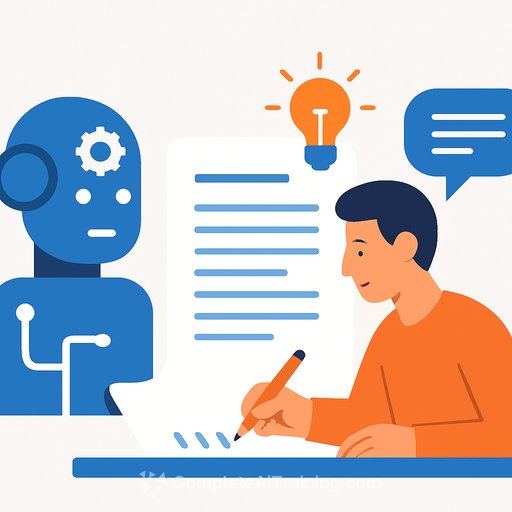
You write like AI. People think it's AI-generated. What now?
If readers say your work feels machine-made, don't argue. Fix the signals that trigger that reaction. This isn't about fooling detectors. It's about writing with proof, voice, and spine.
Why your writing reads "AI"
- It's too balanced. Every sentence is neat, symmetrical, and safe.
- It's generic. Big claims, no names, dates, prices, or consequences.
- It has one rhythm. Same length sentences, same tone, zero texture.
- It lacks a point of view. You summarize instead of taking a stand.
Add proof-of-work
AI guesses. Humans remember. Put receipts in the draft: names, numbers, timestamps, product versions, odd details only you would know.
- Replace "engagement improved" with "CTR jumped from 1.1% to 2.4% in 9 posts."
- Swap "a client" for "a DTC skincare brand doing $400k/mo with 60% of sales from email."
- Anchor scenes: "I wrote it at 5:42 a.m., coffee gone cold, Slack exploding."
Make one strong point
Pick a spine: a single belief that drives the piece. Cut anything that doesn't serve it. Most "AI-sounding" writing tries to cover everything. Let your draft argue one thing well.
Change the rhythm
Vary sentence length. Use a short punch after a long build. Ask a question. Break a pattern on purpose. Controlled imperfection makes it human.
Write to one person
Picture a real reader. Use their words. Answer their problem. If you can't name the person, you'll default to filler and corporate tone.
Trade abstractions for concrete language
- "Leverage data" → "Pull the last 30 days and sort by revenue per send."
- "Consistency matters" → "Publish 3 times a week for 6 weeks. 600 words max."
- "Optimize onboarding" → "Cut step 3. Ask for email after value, not before."
Use simple story frames
- I used to think X. Then Y happened. Now I do Z. Here's how.
- Problem → Tiny win → Steps → Risks → What I'd try next.
- A claim → Evidence → Counterpoint → Why the claim still stands.
Edit like a reader, not a writer
- Read aloud. If you run out of breath, cut the sentence.
- Kill qualifiers: very, really, quite, seems, possibly.
- Cut the first paragraph. It's usually you warming up.
- Swap passive for active: "The draft was approved" → "The client approved the draft."
If a client waves an AI detector report
Detectors are unreliable and biased, especially against non-native writers. Share that up front with sources. Then show your process notes and drafts as evidence of authorship.
Using AI without sounding like AI
Use it to brainstorm, outline, and find gaps. Don't let it finish the piece. Feed it your notes and examples, then rewrite the output in your voice.
- Ask for counterarguments to sharpen your stance.
- Request 10 hyper-specific examples, then verify and keep 2.
- Force constraints: 400 words, second person, one thesis, concrete actions only.
- End with your own story or data. That's the human stamp.
If you want a deeper skill set for steering models, see prompt workflows and role-based courses here: Prompt Engineering and Courses by Job.
Formatting that signals "real writer"
- Front-load value: summary line + clear promise.
- Use subheads that say something, not labels.
- Bullets for steps, not for fluff.
- Quotes and stats with sources, or cut them.
Quick checklist
- One thesis. One reader. One promise.
- At least five specifics: names, numbers, dates, prices, tools.
- Rhythm mix: short, medium, long. A question. A punchy line.
- Cut abstractions. Swap in steps and examples.
- Show your work: notes, drafts, sources.
- Read aloud. Cut 15%.
Bottom line
AI writes averages. Your job is to write proof, point of view, and texture. Do that, and no one will care how you got there-they'll ask for the next piece.
Your membership also unlocks: