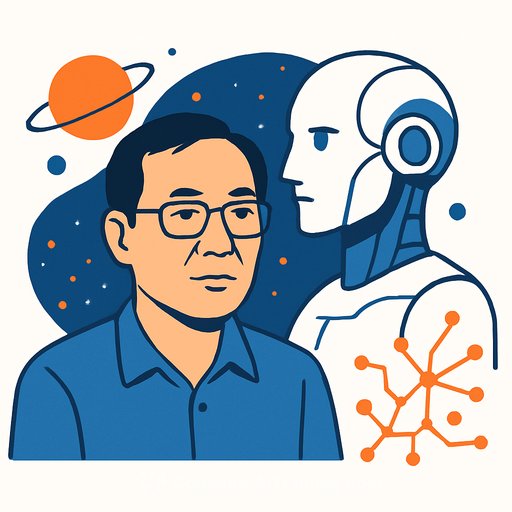
'Rational optimist': Liu Cixin on AI going beyond us - and what writers can do about it
Liu Cixin is the most influential contemporary science fiction writer in China, best known for the Three-Body trilogy that won a Hugo Award in 2015 and inspired TV adaptations in Chinese and English. Born in 1963 in Shanxi, he worked as a computer engineer at a power plant before going full time as a writer in the late 2000s. Influenced early by Arthur C. Clarke, he started writing in the late 1980s.
In October, during a Q&A at the Hong Kong University of Science and Technology where he received an honorary doctorate in humanities, Liu revisited three themes: rational optimism about AI, his "dark forest" lens on risk, and the grind of developing original ideas. Here's what matters for working writers.
Why he'd welcome AI going beyond humans
Liu calls himself a rational optimist. If AI eventually outperforms us, he sees that as progress for intelligence and culture. The goal isn't human primacy; it's continuity. If a new kind of mind carries the torch further, that's a net gain.
For writers, that stance is practical. Treat AI as a collaborator that speeds drafts, pressure-tests premises, and exposes clichés. Keep your edge in direction, taste, and judgment - the parts that set intent and decide quality.
- Define constraints before prompting: genre, stakes, twist, tone.
- Generate options on purpose: 10 outlines → pick 1 → merge 2 → cut 80%.
- Keep a questions-only doc: "What don't I know yet?" Curiosity fuels plot and research.
- Ship small and often: essays, micro-fiction, scenes. Use audience feedback as a filter.
The dark forest, briefly
Liu's dark forest idea frames the universe as quiet because caution rules. Visibility invites risk; silence increases survival. It's a clean template for tension: scarce trust, asymmetric power, irreversible signals.
Read a concise overview of the concept here. Apply it beyond space opera - to social media plots, startup dramas, or political satire - anywhere exposure carries a cost.
Originality is earned, not granted
Liu openly says originality is hard. Even with a global audience, new ideas arrive slowly. That's normal. Treat novelty like engineering: varied inputs, clear constraints, frequent tests.
- Source widely: physics papers, history footnotes, obscure patents, local news archives.
- Cross unlikely pairs: coal power + interstellar etiquette; logistics + myth; bureaucracy + first contact.
- Time-box ideation: 45 minutes to create, 15 to select; repeat weekly.
- Track your clichés: keep a living list you refuse to use.
Origins and influence
Raised in Shanxi and trained as a computer engineer, Liu brought systems thinking to fiction. That blend - industrial grit and cosmic scale - gave his trilogy its distinct texture and helped it travel globally. The lesson for writers: your formative environment is material. Don't sand it down; put it on the page.
What this means for working writers
AI isn't a verdict on your career; it's a new baseline. Let systems handle the first pass. You keep the final cut. Your leverage lives in taste, structure, and perspective - the parts machines imitate but don't initiate.
- Build a reusable idea engine: research pipelines, prompt libraries, beat sheets.
- Write with "thesis → tension → turn" in every piece to hold attention.
- Treat tools like apprentices. Audit their work like an editor.
- Create IP moats: worlds, characters, and newsletters readers trust.
If you want structured ways to sharpen your workflow and toolset, explore curated AI resources for copywriters and authors here.
Call it rational optimism: accept that intelligence may outgrow us, and write work that deserves to meet it. That's a strategy you control.
Your membership also unlocks: