
AI news ·
Experts gather at UNC Chapel Hill to weigh AI's benefits and risks for North Carolina
North Carolina researchers, executives, and officials met at UNC-Chapel Hill to weigh AI's benefits against its risks. Topics ranged from faster cancer detection to job losses and data privacy.
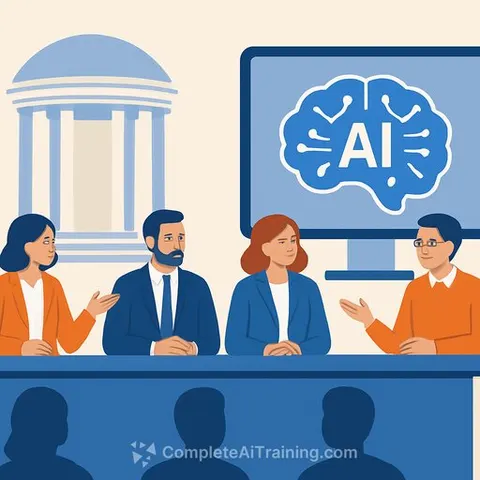
North Carolina Convenes AI Leaders to Discuss Workforce and Medical Benefits - and Job Losses
Researchers, government officials, and industry executives gathered at the University of North Carolina at Chapel Hill this week to examine how artificial intelligence can serve the public while managing its risks. The conversation revealed both concrete medical advances already underway and growing anxiety about employment disruption.
The Education Problem
UNC-Chapel Hill Provost Magnus Egerstedt identified a central challenge: higher education must produce workers ready for AI faster than universities can update their curricula. Students already use generative AI tools, but they need foundational literacy about how these systems work and their limits.
"You've got to be able to use the tools," Egerstedt said. "It's going to take people that can see around corners, who can make new connections, who can keep a finger on the pulse of the future with very limited and oftentimes contradictory information."
Medical Diagnostics Moving Faster
AI is already accelerating cancer detection and treatment planning. Ashok Krishnamurthy, director of the Renaissance Computing Institute, said AI tools now identify cancers and recommend individualized treatment plans in hours or days - a process that previously took months or years.
The impact matters in North Carolina specifically: 41% of colon cancer patients are diagnosed only after arriving at an emergency department, often indicating late-stage disease.
AI is also addressing another bottleneck in medicine. UNC School of Medicine Professor Melissa Haendel said clinical trials for new drugs frequently stall because researchers cannot recruit and enroll enough patients. AI can help streamline that process. Both advances require stronger data infrastructure and privacy safeguards, she added.
Job Market Uncertainty
OpenAI's chief economist Ronnie Chatterji said he monitors employment data monthly to track how AI is reshaping the labor market - and he admits he doesn't know the answer.
"One of my jobs is to watch those numbers every month and try to figure out how long the job market will look the way it does today," Chatterji said. "The other piece of my job is a lot harder, which is trying to tell people what to do with the future."
A report by outplacement firm Challenger, Gray & Christmas found that AI was a leading reason U.S. employers cut jobs in March. Technology companies are replacing coding functions with AI. Other industries are testing whether AI can eliminate roles entirely.
Chatterji, who teaches at Duke University's Fuqua School of Business, said he is preparing a graduation speech for the Class of 2026 but struggling with what to tell them. Research shows that graduating during economic recession or major technological disruption affects wages and career trajectory for 15 years afterward.
His message: leadership still matters. "You're going to need a human at the end of the day to make the decision, make the call, and from a legal perspective, be accountable," he said.
Security Vulnerabilities Spark Debate
Anthropic released Claude Mythos, a powerful AI model that has already identified thousands of high-severity security vulnerabilities in major operating systems and web browsers. Some observers have questioned whether the model should have been released at all.
Thompson Paine, Anthropic's head of geopolitics, told the Chapel Hill audience that transparency is necessary. The company is sharing what it learns with policymakers and security experts so the technology can be deployed safely.
Paine also framed the issue as a strategic concern for the United States. If a Chinese lab had developed Mythos first, he asked, would it have alerted American companies to patch vulnerabilities before public release? The implication was clear: the U.S. needs to lead in AI development to ensure responsible deployment.
Government Agencies Adopt AI Tools
North Carolina State Treasurer Brad Briner said his office is expanding AI use after a successful pilot with ChatGPT. The tool saved time and is now being used to analyze financial data from more than 1,100 municipal governments statewide.
"It's just so enormous, you can't see through the fog," Briner said. "We can see through the fog now. Now we can have a predictive ability to tell the citizenry, your municipality is doing this. We know how this ends."
The agency recently used this capability to flag budget oversight problems in Rocky Mount.
What Users Should Know About Data
Martha Wewer, North Carolina's Chief Privacy Officer, warned that consumers interact with AI constantly without realizing it. She posed a practical question: before clicking on an email offer for a free Chipotle burrito, what should you know?
Read the fine print, said Ogzun Ataman, Chief Technology Officer at Well. Check whether the company retains your personal data, for how long, and whether it will be used to train AI models. "You can choose to allow them to do that, but you should at least be aware of that choice," he said.
DJ Sampath, senior vice president for AI software at Cisco, added that consumers can use AI itself to parse those terms of service. Most people never read them. "That should give you an instant understanding of what am I giving away to be able to get that free burrito," he said.
The core principle, Sampath said, is understanding the trade-off. "What is okay by me, and what is not okay by me?"
To develop competency in these tools, consider exploring ChatGPT courses for practical applications or Generative AI and LLM courses to understand how large language models work.