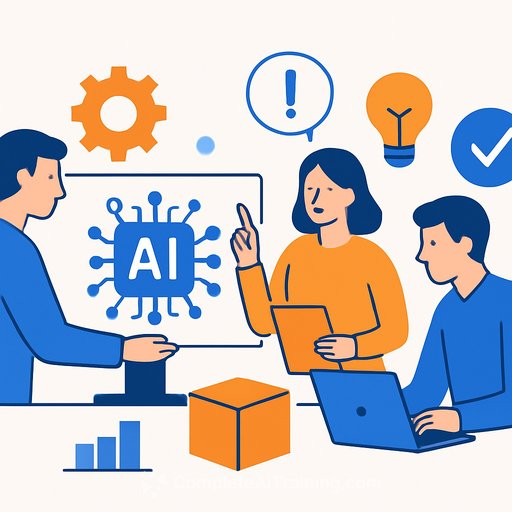
How small enterprises can use AI for product development
Product development eats time and cash. AI won't remove risk, but it will cut the cost and speed of learning. The leverage comes from using it where it moves decisions forward, not where it adds noise.
Below are five high-impact plays product teams can run to sharpen bets, ship faster and waste less.
1. Customer insight at scale
You already have the signals: reviews, support tickets, CRM notes, sales logs, web analytics, and social comments. Use AI to cluster themes, tag sentiment and surface patterns by segment, region and price point. Replace opinions with an evidence backlog you can act on.
- Inputs: support transcripts, survey responses, search terms, returns data.
- Outputs: ranked pain points, recurring feature requests, price sensitivity by segment.
- Metrics: time-to-insight, % backlog items backed by data, NPS/CSAT shifts after fixes.
In diverse, price-sensitive markets like South Africa, this cuts through assumptions and highlights what different customer groups actually value.
2. Validate before you spend
The riskiest move is building the wrong thing well. Use AI to rapidly generate value propositions, landing page copy, and pricing narratives. Test them with small, targeted campaigns. Let real engagement pick the winner before you commit real capital.
- Run "fake door" tests, ad variant experiments and survey-led concept screens.
- Use LLMs to draft 10 positioning angles; ship the top 3 to market the same day.
- Decision gates: CTR, sign-up intent, price acceptance, and qualitative feedback quality.
AI assists with speed and variation. You still decide what's feasible, ethical and on-brand.
3. Design optimisation
Shorten the build-measure-learn loop. For digital products, apply AI to funnel data, session replays and heatmaps to spot friction. For physical goods, use modelling to explore design options, packaging dimensions and material trade-offs before prototyping.
- Digital: predict drop-off points, auto-generate UX copy, test flows with simulated users.
- Physical: generative design for strength-to-weight, cartonisation to reduce freight and breakage.
- Metrics: task success rate, time to complete key flows, material cost per unit, iteration cycle time.
4. Demand forecasting
Cash is king for SMEs. Better forecasts reduce stockouts and dead inventory. Use AI-driven models that account for seasonality, promotions, regional variation and macro shifts. Pair the forecast with scenario planning so ops and finance can agree on ranges, not wishes.
- Integrate historical sales, lead times, MOQs and promo calendars.
- Track MAPE and bias; review weekly with sales and supply to recalibrate.
- Translate to actions: reorder points, safety stock and working capital allocation.
If you want a solid primer on forecasting methods and accuracy metrics, see Forecasting: Principles and Practice.
5. Personalisation
Personalisation lifts perceived value without increasing unit cost. Use AI to recommend bundles, tailor messaging by segment, and adapt service tiers to willingness-to-pay. Keep a human in the loop to respect cultural nuance and context, especially across South African customer groups.
- Start simple: "next best action" emails, cart-based recommendations, segment-specific offers.
- Guardrails: avoid overfitting, monitor fairness, and sanity-check results with frontline teams.
- Metrics: AOV, repeat purchase rate, retention, and LTV/CAC by segment.
A 30-day rollout plan
- Pick one product objective (e.g., lift trial-to-paid by 10% or cut returns by 15%).
- Audit data you already own; fix obvious gaps in tracking and consent.
- Select one use case from above and one tool to execute it. Keep scope tight.
- Define success metrics and a decision gate before any test runs.
- Ship two experiments per week. Review outcomes every Friday. Keep what works, kill what doesn't.
The win isn't the number of AI tools you try. It's the clarity of the problem you're solving and the speed at which you learn. Use AI to generate options and evidence; use judgement to choose the next move.
Want structured ways to apply these plays across your roadmap? Explore AI for Product Development for practical resources.
Your membership also unlocks: