AI in Drug Development: What FDA and EMA Expect From Product Teams
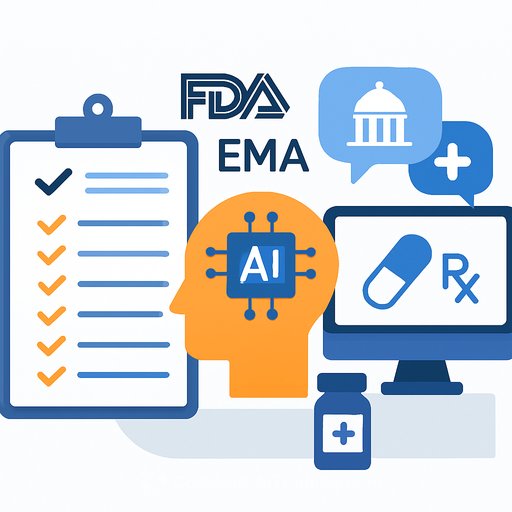
The FDA's CDER and CBER, together with the EMA, have released 10 guiding principles for using AI in drug and biological product development. These are practical guardrails for teams using AI to speed R&D, support pharmacovigilance, and reduce reliance on animal testing-while preserving safety and quality.
The message is clear: use AI to move faster, but do it with discipline. The principles fit the quality bar of regulated development and keep patient benefit at the center.
Why this matters to product development
AI can shorten time-to-market, find signals earlier, and streamline evidence generation. Without solid design, validation, and controls, it can also create noise, bias, or misleading outputs.
These principles give you a framework to build AI into workflows without compromising on data integrity, safety, or regulatory expectations.
The 10 principles you should operationalize
- Human-centric by design - Keep human oversight, ethics, and patient impact front and center across decisions and workflows.
- Risk-based approach - Match controls to risk. Higher-risk use cases need tighter requirements, testing, and governance.
- Adherence to standards - Follow legal, ethical, technical, scientific, cybersecurity, and regulatory standards relevant to your use case.
- Clear context of use - Define where and how the AI will be used, its boundaries, and what decisions it will support (or not).
- Multidisciplinary expertise - Involve clinical, statistical, regulatory, data science, quality, and cybersecurity stakeholders early.
- Data governance and documentation - Protect sensitive data, manage lineage and consent, and document provenance, transformations, and access.
- Model design and development practices - Use processes that support transparency, reliability, generalizability, and stability across populations and settings.
- Risk-based performance assessment - Validate against intended use, edge cases, and failure modes. Calibrate thresholds and define acceptable error.
- Life cycle management - Monitor for drift, retrain with control plans, and re-evaluate performance on a set schedule and after changes.
- Clear, essential information - Communicate in plain language to the intended audience: purpose, limits, known risks, and how to interpret outputs.
What to do next
- Stand up an AI governance group with product, clinical, biostats, data science, QA, regulatory, privacy, and security; for governance frameworks and executive oversight, see the AI Learning Path for CIOs.
- Write a one-page context-of-use for each AI tool: purpose, scope, decision impact, inputs/outputs, and users; regulatory teams can reference the AI Learning Path for Regulatory Affairs Specialists when aligning to submission expectations.
- Create a risk matrix for AI use cases and map controls (validation depth, review steps, audit frequency) to each tier.
- Implement data controls: lineage tracking, consent and privacy checks, quality gates, and immutable audit trails.
- Adopt an AI model development checklist: dataset splits, bias checks, reproducibility, documentation, and explainability where feasible.
- Define performance targets tied to clinical or operational impact, plus guardrails for out-of-distribution and edge cases.
- Set monitoring for data drift and model drift, with triggers for retraining and documented change control.
- Create plain-language summaries for users and reviewers that outline intended use, limitations, and safe-use guidance.
- Pilot in a controlled environment, run pre-specified analyses, and require QA/Regulatory sign-off before scale-up.
- Schedule periodic re-evaluations and stress tests; log decisions and updates for inspection readiness.
The agencies also highlight areas for international policy development, signaling more detailed guidance ahead. For official information and updates, see the FDA's site here and the EMA's site here.
If your team needs practical upskilling on AI and product workflows, explore role-based options such as the AI Learning Path for Data Scientists.
Your membership also unlocks: