AI Is Filling Patient Experience Gaps Healthcare Left Open
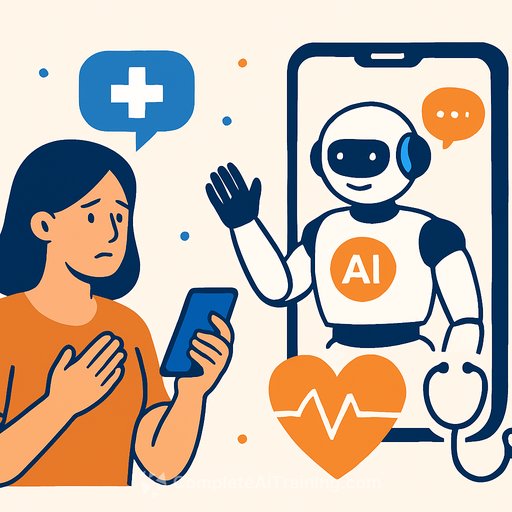
Patients are tired of long waits, clunky scheduling, and confusing insurance. A new Sacred Heart University poll of 1,500 U.S. adults shows many are already turning to AI to get answers and move faster-because traditional systems aren't keeping up.
Medical-specific AI tools are gaining traction not because of hype, but because people have basic needs going unmet. If healthcare doesn't fix access and clarity, patients will keep finding workarounds.
What Patients Already Do With AI
About a third of Americans use AI tools like ChatGPT for health research. Another 61% use AI-powered search for health topics.
Interest is growing in practical use cases: 41% would use AI for personalized reminders, 39.6% for scheduling chatbots, and 36.5% for help reading test results.
Confidence is high, too. Around 42.8% say they're very confident understanding health information and 49.6% are somewhat confident. That confidence encourages DIY behavior-more patients going straight to AI rather than waiting for the system to respond.
Why Patients Turn To AI: Friction We Created
The pain points are predictable. Long wait times (38%). Hard-to-book appointments (24%). Insurance frustration (32%). Financial worry (25%).
When access is slow and benefits are opaque, people will seek tools that give quick, clear answers. AI is stepping into that space.
Patients Want AI Guardrails
People aren't asking for unchecked automation; they want protection and clarity. In the survey, 88% want disclosure when AI is used in their care, 83% want the right to opt out, and 86% want plain-language explanations of how AI is applied.
"This poll shows strong public support for technologies that help individuals easily achieve their health goals, but distrust in the systems and institutions behind them is creating tension and driving calls for transparency and regulation," said Foluke Omosun of Sacred Heart University. "I see this as an opportunity for health communication professionals to help address public concerns by prioritizing ethics, transparency and accountability."
Human Connection Still Matters
Most respondents (64.5%) acknowledge that AI is already used in healthcare. Many see upside: 57% say it could improve access to information and services.
But replacement is a stretch. Only about 38% think AI could replace their doctor in the next decade; 47% say it won't. The message is clear: use AI for speed and clarity, but keep the relationship intact.
"While AI offers unprecedented access to information and operational efficiency, many individuals continue to value human connection, particularly empathy and nuanced judgment," said Anna Price, professor of health science at SHU. "As AI becomes embedded in health decision-support, we need intentional strategies to preserve meaningful human engagement."
The Practical Playbook For Health Systems
- Publish a clear AI policy. Tell patients where AI is used (portals, phone trees, triage, education). Use simple notices and consent flows. Consider aligning with emerging transparency practices such as the ONC's HTI-1 final rule.
- Offer easy opt-outs. Provide "talk to a human" options in portals, phone menus, and chat. Honor preferences across channels.
- Keep a human in the loop. Use AI for reminders, scheduling, insurance Q&A, and test-result explanations-with clear disclaimers and fast handoffs to clinicians for anything diagnostic or complex.
- Set quality and safety controls. Validate models on your patient population. Monitor error types, bias, and hallucinations. Log prompts, review transcripts, and set escalation paths. Track deflection rate, first-contact resolution, and satisfaction.
- Protect privacy by design. Minimize PHI in prompts. Use approved vendors, secure hosting, and BAAs. Align with HIPAA requirements and internal data standards; see FDA context for AI/ML in SaMD here.
- Fix access friction. Let AI for Operations find earliest appointments, manage waitlists, and surface cancellations. Show real-time wait times. Keep phone parity for patients who don't want AI.
- Make insurance and billing understandable. Use AI assistants to decode benefits, estimate out-of-pocket costs, and prep prior auth checklists. Escalate to staff for exceptions.
- Build for health literacy. Provide multilingual options, plain-language summaries, and visuals. For lab results, give a simple summary, what it may mean, and questions to ask your clinician-without offering diagnoses.
- Train your teams. Give clinicians and front-line staff playbooks for safe prompts, red flags, and escalation. If you need structured upskilling, explore role-based AI learning paths here.
Metrics That Prove It's Working
- Time to first available appointment and booking conversion
- Portal and phone response times; message backlog
- No-show rate and refill adherence
- AI interaction CSAT/NPS, opt-out rates, and complaint volume
- Safety events, escalation rates, and clinician override frequency
- PHI leakage incidents and audit findings
Bottom Line
Patients are already using AI because it reduces friction. Healthcare's job now is to make that use safe, transparent, and genuinely helpful-without losing the human connection that makes care feel like care.
Your membership also unlocks: