
AI news ·
Federal agencies use AI to streamline hiring and develop mid-career employees
GSA reduced job classification time from eight hours to two using AI. The savings support an agency goal to reclaim one million work hours through automation.
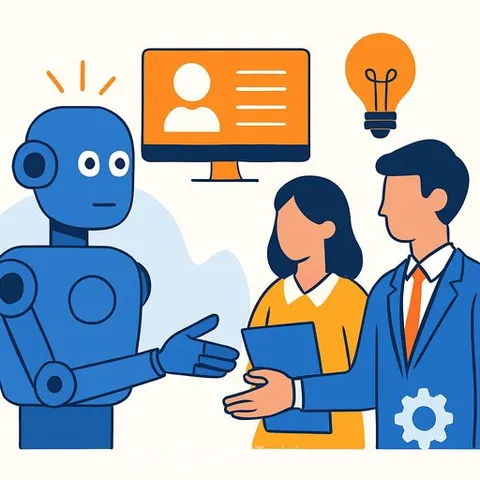
Federal HR leaders said artificial intelligence has cut the time required to classify General Schedule jobs at the General Services Administration from six to eight hours down to about two hours, contributing to a broader push to reclaim one million work hours through automation. The update came Wednesday at an event hosted by software company SAP and produced by Government Executive's parent company, GovExec, where chief human capital officers from GSA and the Chief Human Capital Officers Council detailed how agencies are using technology to sharpen hiring assessments and develop mid-career talent.
AI speeds job classification at GSA
Arron Helm, GSA's chief human capital officer, said the agency runs 500 to 600 job classifications each year. Using AI to draft initial narratives and evaluate factors has let HR teams cut the average per-classification process dramatically. "Our teams still need to go back in there, they still need to work it and massage it and come to agreement, but now we're averaging about two hours to do what was taking six to eight hours," Helm said.
The gains at GSA reflect a broader federal trend of applying AI for Human Resources to speed routine classification and hiring tasks. The time saved folds into GSA Administrator Ed Forst's "million-hour moonshot," which aims to identify one million work hours that can be eliminated, optimized, or automated. So far, the agency has found 600,000 hours, Helm added.
Shifting from self-assessments to formal evaluations
Colleen Heller-Stein, executive director of the Chief Human Capital Officers Council and former deputy Treasury CHCO, praised the Trump administration's move away from applicant self-assessments and toward formal evaluations, particularly for AI-related roles. "This is seen as a return to merit, where people are showing what they know, not just saying, 'Hey, I know all of this,'" she said.
Helm added that feedback from hiring managers has been "phenomenal" and that candidate quality "is so much higher than what they're accustomed to in the past." This adoption of AI for Government is reshaping how agencies evaluate and place talent, and it aligns with an effort to consolidate more than 100 agency personnel systems into a single platform. Heller-Stein said that consolidation could allow the government to quickly tap employees with the right skills across agencies during crises.
Mid-career development as a priority
While both the Trump and Biden administrations focused on bringing early-career talent into government, Heller-Stein and Helm stressed that mid-career employees need equal attention. After recent civil service cuts, Heller-Stein said, mid-career staff "are moving into leadership roles sometimes more quickly than may have been anticipated" and there is a push to "build back that bench."
She noted that the Tech Force initiative, designed to recruit early-career technologists, also brings private sector managers into temporary agency roles. Office of Personnel Management Director Scott Kupor said in May that hiring was lagging for the program with only three or four mid-career workers in the onboarding process.
Helm described GSA labs, a program where early- and mid-career employees from different teams collaborate on agency-wide challenges like measuring AI value and improving contract oversight. "Talent development is something that's often been underfunded and underfocused in the government, so we are really building out and investing in our internal talent development pipelines," he said. "We talk a lot about talent acquisition, but just as important, if not more important, is continuing to grow our internal talent."
Why this matters for management
For managers in any sector, the federal approach offers a concrete example of how AI can reduce administrative drag while raising the bar on candidate quality. Shifting from self-reported skills to demonstrated expertise, especially for specialized roles, can directly improve team performance. The dual focus on early-career hiring and mid-career development also points to a need for internal talent pipelines that don't overlook experienced employees who may need new leadership support faster than expected. As GSA's experience shows, even a few hours saved per process adds up when repeated across hundreds of actions - a lesson that applies far beyond government.