Federal AI Executive Order Addresses State-Federal Regulatory Tensions
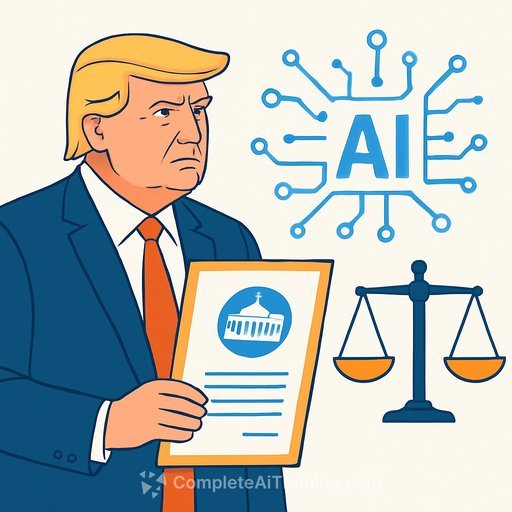
On December 11, 2025, President Trump issued an Executive Order (the "Order") aimed at aligning federal and state approaches to AI regulation. It does not nullify existing state laws. Instead, it sets up litigation, funding, and agency processes that could push the U.S. toward a more uniform national policy over time.
For organizations building or deploying AI across multiple states, this adds another layer to policy planning. State rules still apply for now, while federal agencies assess conflicts and explore legal and legislative paths to preemption.
What the Order Does
- National policy framework: Declares a federal objective for a uniform and "minimally burdensome" approach to AI oversight. It emphasizes preventing censorship, upholding copyright, and protecting children while supporting domestic AI development.
- AI Litigation Task Force (30 days): Directs the Attorney General to form a task force to identify conflicting state AI laws and bring legal challenges based on preemption, the Commerce Clause, First Amendment, or other constitutional grounds.
- State law review (90 days): Requires the Secretary of Commerce to publish an evaluation of current state AI statutes, flagging laws seen as inconsistent with national objectives-especially those that mandate specific AI outputs or impose disclosure/reporting rules with constitutional issues.
- Conditional federal funding: Instructs agencies to consider tying eligibility for certain grants-such as the BEAD broadband program-to state alignment with national AI policy. States may be asked not to enforce specified provisions as a condition of discretionary funds.
- Federal standard development: Directs the FCC and FTC to initiate proceedings on AI reporting/disclosure standards and on applying unfair or deceptive practices rules to AI models under the FTC Act.
- Legislative package: Calls for comprehensive federal AI legislation that would preempt conflicting state laws, with carve-outs for child safety, critical infrastructure (including data centers), and government procurement.
What It Means Right Now
- State laws still apply: The Order does not suspend or override state AI requirements. Compliance remains mandatory unless a court enjoins enforcement or a state changes its law.
- More federal litigation is likely: Expect targeted challenges to specific state provisions. Companies may face shifting requirements in states where litigation creates uncertainty.
- Funding leverage: Federal grants could become a policy lever. If your projects touch telecoms or infrastructure, watch for new terms that tie eligibility to state regulatory posture.
- Movement toward federal standards: FCC/FTC actions may start to define baseline disclosures and how UDAP applies to AI. Actual preemption will hinge on statutory authority and court interpretation.
- State responses: Some states may amend laws to fit within the Order's stated exceptions (child safety, critical infrastructure, procurement) while keeping core policy goals.
Actions for IT, Product, and Legal Teams
1) Map your exposure to state AI laws
- Inventory where your AI systems are deployed and which state rules apply (e.g., bias assessments, transparency, data governance, documentation, audit logs).
- Flag mandates that force specific outputs or impose disclosure/reporting duties that might be targeted for federal review.
2) Stress-test compliance programs
- Ensure model cards, system cards, impact assessments, and data lineage are current and accessible.
- Confirm controls for child-safety features, content moderation policies, and copyright-respect mechanisms.
- Bolster logging, versioning, and rollback plans for models in production to support quick updates during litigation-driven changes.
3) Review federal funding risk
- Identify projects tied to federal or state-administered grants (particularly telecom and infrastructure).
- Prepare for potential funding conditions that require commitments regarding state law enforcement or reporting practices.
4) Monitor federal agency moves
- Track the Commerce Department's 90-day state law report for a preview of likely litigation targets.
- Watch FCC/FTC proceedings for baseline disclosure and UDAP interpretations that could reshape product and marketing claims.
- Engage in comment periods where your systems, markets, or customers are directly affected.
5) Update governance and board reporting
- Add a standing agenda item for AI regulation. Include state-by-state status, federal actions, and potential preemption scenarios.
- Define triggers for policy changes (e.g., preliminary injunctions, final agency rules, grant condition updates) and who owns the response.
Near-Term Timeline to Watch
- 30 days: DOJ forms the AI Litigation Task Force and begins identifying state-law conflicts.
- 90 days: Commerce publishes the state law evaluation. Expect early signals on which statutes could face challenges.
- Following months: FCC/FTC proceedings begin. Proposed standards and enforcement interpretations may set de facto guardrails ahead of any new federal statute.
Practical Checklist
- Confirm state-law coverage for each AI system and market.
- Centralize your AI documentation (design choices, training data sources, evaluations, known risks, mitigations).
- Reassess model disclosures and marketing claims for UDAP exposure.
- Align incident response with legal hold and discovery needs in case of litigation.
- Track grant-dependent projects for new eligibility conditions.
Bottom Line
The Order's immediate effect is procedural, not sweeping. But it sets machinery in motion-litigation, funding conditions, and agency standards-that can meaningfully change AI obligations over the next several quarters.
Stay compliant with current state rules, keep your documentation tight, and be ready to pivot as courts and agencies weigh in. Early preparation will save time and reduce churn if requirements shift quickly.
Your membership also unlocks: